Grow First, Clean Later? Not So Fast
Welcome back! Today we're taking a closer look at the Environmental Kuznets Curve (EKC), the classic theory that pollution rises with industrialization and then falls as economies mature, and where it starts to break down in practice, including a modification that helps explain why the turnaround happens later than the simple model predicts.
The Inverted-U Hypothesis
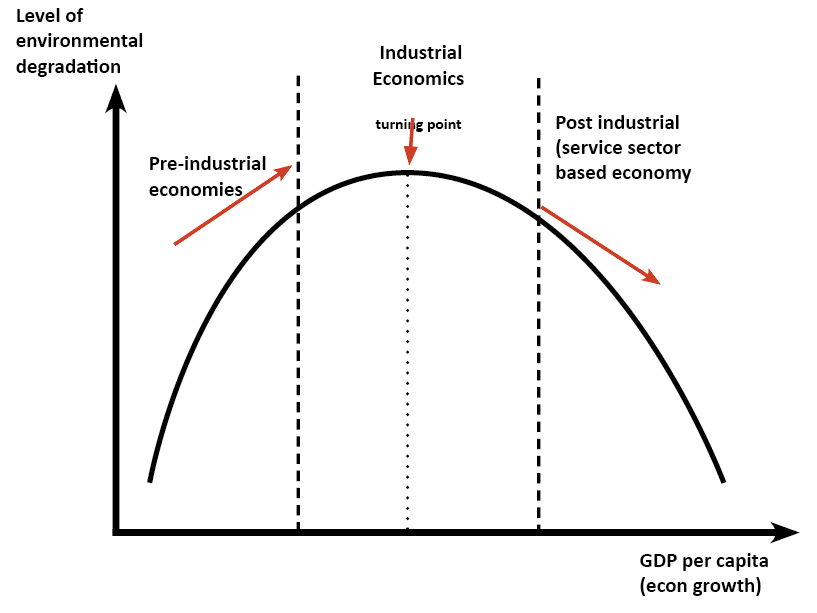
Environmental Kuznets Curve (EKC), which is based on the pioneering work of Kuznets (1955), indicates the inverted U-shape relation between per capita income and environmental deterioration whereby environmental deterioration increases with industrialization and thereafter decreases as the economy matures. Grossman and Krueger (1991) found empirical support for this pattern, showing sulfur dioxide and particulate matter concentrations peaked and declined near per capita incomes of $4,500 (1985 dollars). This apparent turning point suggested that income growth and broader economic growth were the driving mechanisms of environmental improvement.
However, this hypothesis is more fragile in practice than it might appear. CO2 emissions, for example, do not follow the inverted-U pattern across multiple income ranges, partly because wealthy nations have not curbed emissions and cleaned up "dirty" production. At the graph's center, estimates vary across many studies, and the lack of a tangible mechanism connecting growing wealth to environmental progress makes the "simple" theory structurally questionable. Economists Jeffords and Thompson step in to remedy this gap, finding that income alone is not the sole determinant of environmental concern, but rather that individuals must meet a minimum threshold before they can afford to prioritize the environment.
The Minimum Consumption Requirement
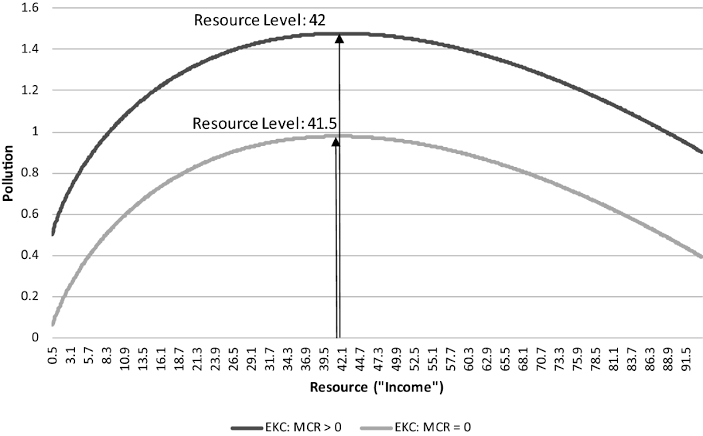
Jeffords and Thompson (2019) modify the EKC model by introducing a theoretical minimum consumption requirement (MCR). This requirement establishes that a baseline level of consumption is necessary for households, but meeting that baseline is not environmentally free: doing so draws on resources. It creates pollution in its own right, and mitigating that pollution requires resources of its own. Below this baseline, environmental concerns are theoretically not on households' financial docket, with their preferences for these issues below the effective societal demand, because whatever income they have is still going toward meeting the baseline itself. At or above the MCR, environmental concern becomes economically feasible, enabling households to meet the societal demand for environmental causes. Still, this only occurs once the cost of meeting the baseline has already been absorbed. Since the crossing of this threshold involves an environmental price, the stage of reaching the level where the environment will be prioritized comes later rather than earlier than is predicted by the traditional model. Therefore, the turn-around of the EKC happens more to the right in reality than in theory because it requires the satisfaction of marginal consumption requirement (MCR) that in itself has an environmental price and only after that income will be channeled towards the levels where improvement of the environment begins.
While in the traditional EKC the impact of income on environment is seen as one-dimensional, the Jeffords-Thompson variation sees it as two-dimensional because the cost of satisfying the consumption floor is a new element that should also be considered. The MCR carries a direct policy implication: it complicates the "grow first, clean later" logic, because Jeffords and Thompson's model shows that guaranteeing a consumption floor is not something economic policy gets for free environmentally, and traditional income-growth accounts of the EKC do not price that cost in. Durable environmental policy accounts for who is being asked to meet a consumption floor and what environmental burden that imposes along the way, fostering the aforementioned financial capabilities only after their real cost has been reckoned with, rather than assuming income growth alone will eventually take care of it. This is precisely the mechanism this paper argues for: policy that accounts for who is impacted, both positively and negatively, produces greater societal and environmental durability than vague policy that overlooks the populations it is meant to serve. The remainder of this paper works to test this assertion. Section VI tests whether this dynamic is visible in a real policy case, New York's first year of congestion pricing, and whether the households closest to the consumption floor bore the toll's cost the way the MCR model would predict, or whether it was a different population driving the political opposition instead.
The idea that economies simply grow their way to a cleaner environment turns out to be too clean a story: the curve's turning point moves further out once you account for the real cost of meeting a basic standard of living first. Cleaner air isn't something growth delivers automatically; it's something that has to be paid for, and who pays first still shapes when it arrives.
References
Kuznets, S. (1955). Economic growth and income inequality. American Economic Review, 45(1), 1–28.
Grossman, G. M., & Krueger, A. B. (1991). Environmental impacts of the North American Free Trade Agreement(NBER Working Paper No. 3914). National Bureau of Economic Research.
Jeffords, C., & Thompson, A. (2019). The human rights foundations of an EKC with a minimum consumption requirement: Theory, implications, and quantitative findings. Letters in Spatial and Resource Sciences, 12(1), 41–49.