Institutional Capacity Is Not Enforcement: Rights, Enforcement Cost, and the Case of New York’s Congestion Pricing
Abstract
This paper examines why environmental policies that appear efficient in economic theory encounter structural limits in practice once rights and institutional capacity are taken into account. Building on economist and Villanova professor Dr. Chris Jeffords's research, this paper argues that institutional capacity alone does not determine whether a constitutional environmental right (CER) is effective in practice. Enforcement cost determines its effectiveness, defined by Ronald Coase (1960) as the cost of protecting against a given harm: a right is valuable only if it can be implemented at a cost below the harm it protects against. This argument is developed through two original research contributions: a claim-level codebook of New York City's congestion pricing litigation, coding 36 claims across 12 cases for whether courts reached the merits and how many pages of substantive legal analysis each claim received, and a comparative analysis of first-year air-quality evidence against Pigou's (1920) toll model, reframing the contested improvement as confined to or near the monitoring points rather than citywide. Together, these contributions reveal the paper's central research finding: institutional capacity in New York was abundant, yet no court ever decided any of the four Green Amendment claims on their merits. This was not due to a lack of institutional capacity, but to high enforcement costs, showing that high institutional capacity can go unexercised even when fully present. The reframing of air quality extends the same logic outside of the courtroom. By failing to have a citywide impact, the toll demonstrated that even a well-funded, well-executed instrument can run into a version of the same enforcement-cost limit that kept the Green Amendment from ever reaching the merits.
Introduction
In June 2024, weeks before New York City's (NYC) congestion pricing program was set to launch, Governor Kathy Hochul paused it, citing concerns that the planned $15 toll would burden commuters and small businesses during a difficult economic moment (New York State Governor's Office, 2024). The program resurfaced after the general elections in November 2024, with a lower toll of $9, a 40 percent cut from the earlier proposal (Mass Transit, 2024). The program began operations on January 5, 2025, in Manhattan below 60th Street, being the first congestion pricing program adopted in America (CBS New York, 2025).
In February 2025, the U.S. Department of Transportation under the Trump administration moved to rescind federal approval of the program. Tolling continued during the subsequent litigation, and on March 3, 2026, the Southern District of New York entered summary judgment against the Department for acting arbitrarily and capriciously (MTA v. Duffy, No. 25-cv-1413). Some results that were evident from the first year of implementation of the program include fewer cars entering the zone by 27 million (11 percent decline); faster-moving buses in selected corridors with 24 percent increase in Lincoln Tunnel express bus corridors (Metropolitan Transportation Authority, 2025); lesser effects on local crosstown buses; revenues above $550 million; and air quality improvements (New York State Governor's Office, 2026; Jeffords, 2026, working paper)
This paper traces the trajectory of NYC's congestion pricing program, from its inception and subsequent modifications to its ultimate evaluation through data. To fully understand NYC's congestion pricing and its economic effects, Coase (1960) provides a useful analytical framework. If a right, or policy tool, can only be exercised at a cost that exceeds the damage it mitigates, it may as well not exist. This paper argues that the space between economic efficiency and enforcement cost fills that void.
Professor Chris Jeffords's research demonstrates that economic models and tools have limitations: outcomes on topics like human rights and institutional capacity depend not on the models themselves, but on the rights in place and the institutions that enforce them. His research shows that environmental rights written into a constitution lead to positive impacts when institutions can uphold and implement them. This paper challenges that claim directly with the case of New York, rather than merely assuming it as truth. This relates to the congestion pricing paradox, which largely depends on follow-through.
Jeffords's research raises a central question this paper takes up directly: why do environmental policies that appear efficient in economic theory meet structural limitations in practice, especially when rights and institutional capacity are considered? This paper argues that institutional capacity alone does not determine whether a constitutional environmental right is protected in practice. What determines this is enforcement cost, in Coase's (1960) sense: a right is valuable only to the extent that it can be implemented at a cost below the harm it guards against, and the gap between what theory predicts a right or policy mechanism will deliver and what its enforcement actually costs in application is the same gap this paper traces through both the Green Amendment litigation and the air-quality evidence below. High enforcement costs tend to steer litigants and courts toward more established legal frameworks rather than the less mature Green Amendment, leaving capacity unused. The Methods Appendix discusses several reasons this may be true beyond enforcement costs alone. Litigation over NYC’s congestion pricing program provides an example where capacity was unlikely to have been a constraint. It thus offers a relatively clean test of whether enforcement cost is, in fact, the bottleneck this paper asserts. The remainder of the paper makes and tests this claim in two parts. Section II reviews the literature on the origins of enforcement on which the remainder of the paper relies. Section III presents this paper's claim-level coding of congestion pricing litigation in New York, which directly tests the argument above. Section IV turns to congestion pricing itself in New York, assessing whether the toll performed during its first year as theory would predict. The Conclusion considers what these two tests suggest about enforcement cost as a limitation on institutional capacity.
The Roots of Enforcement: From Externalities to Enforcement Cost
Externalities and Policy
This section supplies the theoretical vocabulary the rest of the paper tests against New York: how an externality gives rise to a policy response, and how that response, in turn, raises the enforcement-cost question Section III applies directly. At its core, environmental economics posits that markets neglect environmental protection because pollutants released as emissions and waste impose costs on consumers and society as a whole. Pigou (1920) defined this as an externality, or a cost to a third party, and described the Pigouvian tax as a price-based instrument that taxes polluters not for how they behave but for the social cost their behavior imposes on society. It is sometimes mistaken for an externality itself but is instead a solution to correct for one. Because a third party pays this cost rather than the party that creates it, market forces alone will not automatically internalize the externality; some policy instruments must limit firms' ability to dump pollution costs on others. The intuition here explains why there should be a policy response to an externality, but not whether that policy, once implemented, can function as intended. To answer the latter, consider that New York's congestion toll is itself a Pigouvian price on the externality of driving. The first-year performance evaluation in Section IV, when compared with the model's predictions, thus offers a direct assessment of how this notion functions in practice.
Public Goods, Rights, and the Enforcement-Cost Gap
A Pigouvian price is just one policy tool, and it assumes a market mechanism to transmit the price signal to the appropriate agents. Other aspects of our environment do not lend themselves to this valuation method. Public goods theory holds that certain goods and services are not distributed through the free market. Because of this, governments must provide for themselves. Public goods theory helps explain market failure for goods like clean air and climate stability. Both are non-rival and non-excludable, so one can enjoy their benefits without helping to provide them. This is called the free rider problem. Hardin (1968) wrote about this dilemma in his famous article “The Tragedy of the Commons.” Hardin postulated that users of common pool resources would eventually destroy the resource if left unchecked by government intervention. Ostrom (1990) later showed that, under some circumstances, communities of common-pool resource users could develop their own governance institutions without government involvement.
Together, these two pieces complement each other in identifying the same need: effectively dealing with an externality requires an entity, governmental or not, with the power to enforce it. This is the policy gap: A policy, no matter how impeccably designed, might falter during implementation if the body tasked with its enforcement lacks both the capability and the motivation. Capacity and incentive are independent of policy design. This is where a rights-based approach can come into play. Granting rights to a clean environment does not simply change the narrative around environmental protection; it changes the nature of that protection. If that protection is given constitutional weight, it is no longer a policy to be upheld or overturned by politicians. Instead it becomes something that can be legally demanded independently of politics. Constitutional environmental rights lead to strong outcomes, Jeffords finds, only where institutions exist to support them.
Institutional capacity to enforce a right, however, is not the same thing as a right's actual enforcement. Bridging those two and determining whether a right or policy lives up to its theoretical potential is enforcement cost: namely, in Coase's (1960) sense, that a right is valuable only to the extent it can be enforced at a cost lower than the harm it remedies. In the litigation context at issue here, enforcement cost is not a dollar amount paid by any particular stakeholder, but instead a measure of how fully a right gets litigated once invoked: whether a court will even engage the merits of a claim, and if so how much substantive scrutiny it receives relative to other claims presented in the same lawsuit. It follows that the effort required to enforce a right need not match the institutional capacity (or lack thereof) to enforce it, and that mismatch is the gap this paper seeks to understand. Section III operationalizes this gap directly and tests it against New York's Green Amendment litigation.
III. Constitutional Environmental Rights: Enforcement Cost in Theory and Practice
The Global Spread of CERs: Capacity Present, Enforcement Uncertain
This section supplies the paper's central test: does New York's Green Amendment litigation match what Section II predicts about enforcement cost? Fewer than 10 nations around the globe had explicitly stated constitutional provisions supporting environmental rights in 1970, and that number has grown to more than 100 in the decades since (Boyd, 2012). Gellers (2017) attributes this growth to the combined influence of law, political science, and sociology in shaping how these rights spread. These constitutional rights, abbreviated as CERs, include substantive measures, such as guaranteeing the right to clean air and water and measures that maintain a nation's environment, as well as procedural measures, such as altering the nation's justice system to accommodate environmental concerns.
Jeffords's quantitative research across several studies reveals that countries with CERs experience significantly greater environmental improvement than countries without them. Jeffords (2016) finds that constitutional provisions are associated with measurable gains in access to improved sanitation facilities and water sources over time. Jeffords and Minkler (2016) extend this to a broader set of environmental outcomes and find that nations with CERs that have the institutional capacity to sustain them achieve the greatest levels of environmental progress: a high-quality judicial system, combined with civil society and the rule of law, helps enforce CERs, while nations with lower income and structural capacity, even with the same constitutional provision, achieve minimal progress. Jeffords (2021) extends this research further still, finding a significant relationship between CER adoption and improvement on the composite Sustainable Development Index. Even in places with sufficient institutional capacity, however, Jeffords's cross-national research leaves unanswered a question this paper addresses: if that capacity exists, is it actually used to enforce the right, or does cost prevent its use no matter how much capacity there is?
A Rights Jurisdiction Under Stress: Measuring Enforcement Cost in New York, 2024-2026
To answer that question, we need a jurisdiction where institutional capacity is not itself in question. We need a place where you cannot explain any failure to enforce the right as a lack of judicial capacity, civil society, the rule of law, etc. Few places meet that bar as clearly as New York. It has a judiciary independent from the rest of the state, has dealt with a great deal of high-stakes litigation in the past, particularly in finance and economics, and enacted a CER, the Green Amendment, that carries broad public support. The Green Amendment, ratified in 2021, guarantees each person's right to clean air and water and a healthful environment. Coase (1960) describes a right as valuable only to the extent that an individual can access it at a cost lower than the harm it protects against. Here, the Green Amendment functions as the property right to a clean and safe environment, and litigation is the mechanism used to price and enforce it. If institutional capacity fully supports rights enforcement and the mechanism proves effective, this would be the best example.
To test this, we reviewed 12 court cases regarding the congestion pricing initiative from 2023-2026 in NYC, with 36 claims, and organized the findings in a codebook. One criterion applied to all cases: coded under the merits rule stated in the Methods Appendix. Case selection used the Regional Plan Association's litigation compendium (n.d.) and Pace Law School's environmental litigation repository (n.d.); coding was based on the courts' written opinions, and another researcher independently coded 25% of the sample to validate the coding.
According to the results, only 4 of 36 coded claims involved the Green Amendment, and none reached the merits. In the package of three cases dealing with the toll ban, which the court ruled on collectively on April 17, 2025, in an opinion written by Judge Liman, claims under the Green Amendment were dismissed with prejudice as a matter of law for failing to state a claim. Through an economic lens, the opportunity cost of rejecting the Green Amendment claim was essentially zero dollars. In contrast, the opportunity cost of either upholding or rejecting the claim on its merits never materialized because the court never reached the question. That near-zero price stemmed from how little judicial scrutiny it received before being tossed aside: one sentence per case rather than any substantive evaluation of the likelihood or extent of the injury the right was intended to avoid. Note again Chan and Mulgrew, the two cases where plaintiffs raised both claims. The Commerce Clause received eighteen pages of discussion and analysis and Right to Travel twenty-five, but the Green Amendment received less than a page of analysis combined. For another data point from that same corpus: Trucking also raised a Supremacy Clause claim. Replicated via the same April 17 dispositive order but through its own-headed claims analysis, Trucking's Supremacy Clause claim was discussed at length for three whole pages by the court before it was rejected; that is three times the number of pages any one of the five coded claims were discussed throughout the entire census on a claim plaintiffs ultimately lost just as much as Green did. Even across the dispute, the same general principle applies: when the litigation decided the fate of congestion pricing, MTA v. Duffy decided March 3, 2026, the Green Amendment question was never raised, and the case was resolved on traditional principles of administrative law.
In Duffy, counsel's own reservations about the Green Amendment meant the issue never reached a judge. This reality does not undermine this paper’s argument, even though Duffy tested no court's institutional capacity; it reinforces it. Duffy's lack of court-side proof is predicted by the enforcement-cost mechanism described throughout the rest of the census, since a court's institutional capacity can be chilled by cost before it is ever called upon to act, and an unpled claim is simply the earliest stage at which that chilling can happen.
One case in this census warrants closer attention before we take this pattern as settled. Riders Alliance's earlier case, Riders Alliance v. Hochul, might seem to complicate this pattern, since it is the one case in the census where a Green Amendment claim survived a motion to dismiss rather than being dismissed outright. Closer inspection reveals that even this example does not break the pattern. The court's discussion of the Green Amendment was limited to one page addressing only standing (whether the plaintiffs had the right to bring the claim), not the merits (whether the tolling suspension actually infringed the right). The court based its ruling on an alternative, non-constitutional theory of law. The court never reached the merits of the Green Amendment itself. The case was voluntarily dismissed in January 2025 after Hochul tolled the law before any court could reach that question. Far from being a unique outlier, Riders Alliance exemplifies the same phenomenon the rest of this census demonstrates. Still, with finer focus: the Green Amendment barely clears a procedural hurdle to keep litigation going while other legal arguments do the heavy lifting. This paper argues the consistency of this pattern and pursues one likely explanation: counsel's own cost-benefit analysis, without claiming to explain every possible cause. The Methods section discusses additional possibilities.
On the other hand, considerations such as the existence of stronger legal grounds (the Commerce Clause) carried far more weight in the court's decision. Institutional capacity mattered less when the case could be decided on alternative grounds. This court had the space to scrutinize the Green Amendment's constitutionality closely. It simply refused to, devoting eighteen pages to another claim after killing the Green Amendment in one sentence. The key twist is that existing institutional capacity and capacity spent on the given right are not the same thing, and this paper's evidence supports that assertion. Put simply, the court had the capacity to engage the Green Amendment closely; it simply did not, because doing so cost more than routing around it did.
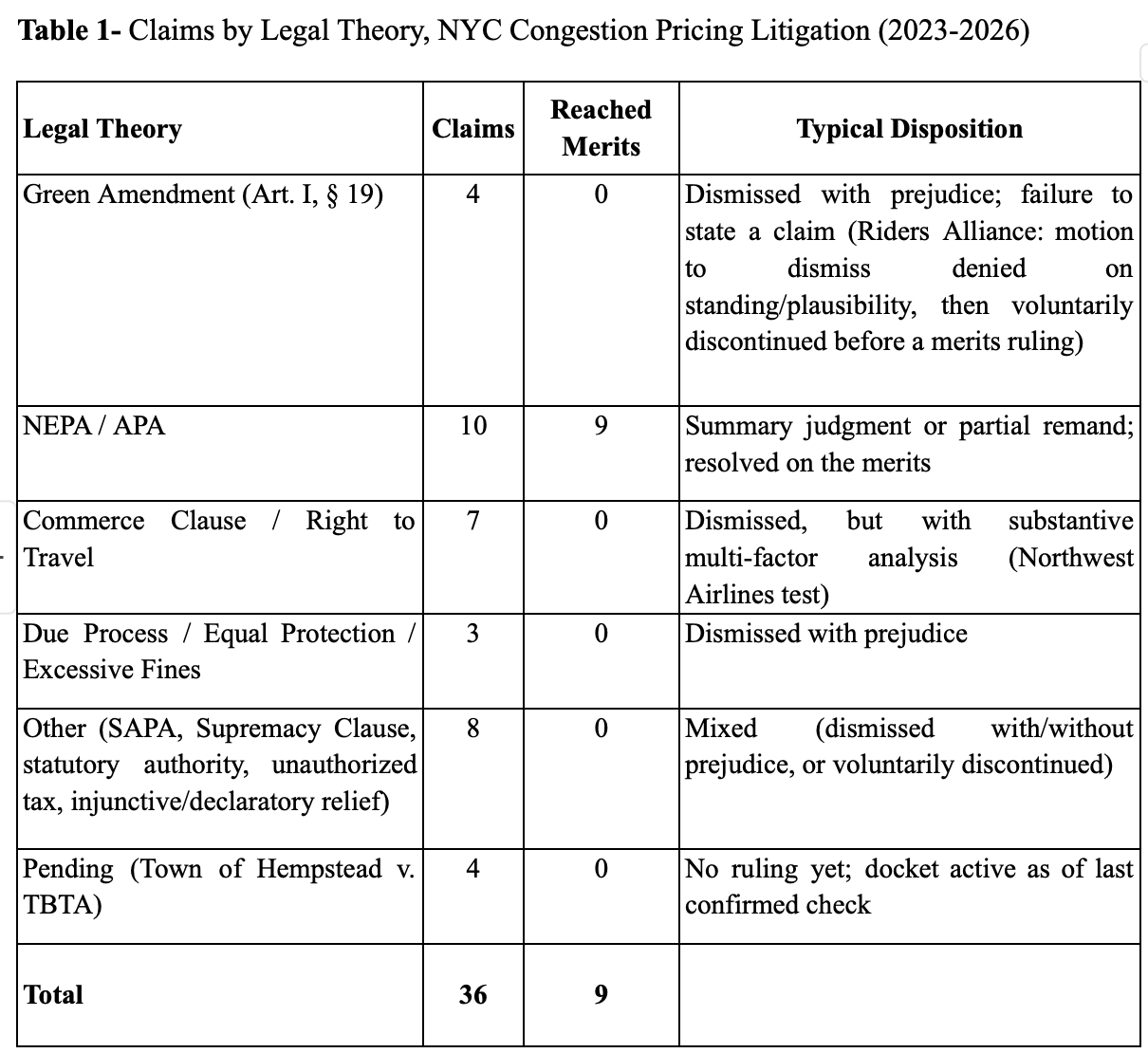
Note. N = 36 claims coded from 12 cases. "Reached Merits" reflects application of the following rule (see Methods Appendix for more detail): If the court reached the merits of the claim, that is, it specifically evaluated whether or not the agency's action violated the underlying legal theory, then we count that claim as having reached merits. However, if the claim was dismissed due to lack of standing, mootness, or failure to state a claim upon which relief can be granted, we do not count it as reaching merits. The Pending row includes the four claims from Town of Hempstead v. TBTA, which had not yet been resolved at our last confirmed docket check. Appendix A includes complete claim-level coding with sources and coding justifications.
Table 1 presents this count. Of the 36 total claims coded, the Green Amendment is a clear outlier: No Green Amendment claim ever reached the merits. In contrast, other legal theories, several of which are quite established, saw claims reach a merits decision substantially more often. The institutional capacity to hear these claims was never maxed out at any point on this record. The same courts with the same dockets and (frequently) the same opinions resolved claims that reached full merits review and those that did not. What differed was not the courts’ capacity to meaningfully exercise the right but the price of exercising it relative to other options.
IV. Congestion Pricing: Economic Theory and Political Reality
The Congestion Externality and the Optimal Toll
Section III tested enforcement cost using a legal right, the Green Amendment, as the test case. This section tests the same underlying constraint using an economic instrument instead: New York's congestion toll. Roads and highway systems have long functioned as a common-pool resource, used without restriction by society (Ostrom, 1990). In this system, drivers interact in a congested network that creates internal delays, with a few road-goers causing a traffic backlog without experiencing it themselves. This is called the congestion externality, and it is precisely the problem New York's congestion pricing program was built to correct below 60th Street in Manhattan. Pigouvian theory suggests that each driver imposes a marginal external cost on the system they drive in and should be charged for it. Walters (1961) and Vickrey (1969) gave the following equation for this fee. Also known as a "toll" fee, it was what New York ended up using with their $9 charge after their 2024 hiatus. Let AC(q) equal the average cost of a trip given the amount of traffic q. This produces a marginal social cost of:
MSC(q) = AC(q) + q × [dAC/dq]
The second term, (q[dAC/dq]), is an externality; The cost incurred by another person that generally goes unpaid for. It's the additional delay per driver multiplied by the number of drivers in the system (road). The socially optimal toll under ideal conditions would equal the cost you impose on others but uses the target traffic level instead of today's. The question this section takes up is whether New York's toll actually behaved the way this model predicts, or whether enforcement cost became a binding constraint here too, the same way it did for the Green Amendment in Section III. The Conclusion returns directly to this question.
Global Evidence: London, Stockholm, Singapore, New York
Beyond the analysis of the New York toll, the model has not been tested independently, as many cities have implemented the same instrument, allowing an analysis of what the theory should predict outside the textbook. Moreover, empirical estimates in the international literature on the relationship between congestion charging and efficient markets are remarkably uniform. London's Congestion Charge reduced traffic by 15 to 20 percent overall after its introduction in 2003. Congestion, measured as excess delay, fell by about 30 percent, and revenue generated reached more than £130 million per year for England's transit system (Leape, 2006; Transport for London, 2007). Stockholm's congestion charge reduced inner-city traffic flow by 20 to 25 percent after it was implemented in 2007 and cut CO2 emissions by approximately 10%. Overall, welfare studies such as those by Eliasson et al. (2009) and Börjesson et al. (2012) found that congestion charging yields net social benefits after accounting for administrative costs. The Singaporean case shows how congestion pricing may be implemented without political intervention by combining it with a broader transportation policy. Singapore began a trial of its road pricing mechanism with the Area Licensing Scheme in 1975 and fully implemented ERP electronically in 1998. The point is that these three cases are useful here for one reason: they show what the standard Pigouvian model yields when put into practice in cities with very different institutions and enforcement stringency, and thus provide the benchmark against which New York's first-year performance can now be measured.
Returning to New York, however, the authors note that the estimated improvement in air quality should be interpreted as local rather than citywide. Fraser et al. (2025), deploying 42 monitors throughout the greater city region, report a 3.05 µg/m³ (22 percent) decline in PM2.5 within the treated Congestion Relief Zone, alongside smaller declines of 1.07 µg/m³ across the five boroughs and 0.70 µg/m³ in the surrounding suburbs. This effect weakens with distance from the toll zone but does not disappear. Jeffords (2026) estimates a relative reduction in PM2.5 concentrations at treated monitors after policy implementation using an hourly monitor-level panel tied to both the policy's legal boundary and its hourly tolling schedule. This relationship holds up even after checking the result against tests that randomly assign which monitors count as "treated." However, he emphasizes that this is only a policy-time association at the monitor level and not a causal estimate for the city as a whole. Cook et al. (2025) find no evidence of improvement in air quality within the CBD using a different dataset and city-level controls, where the estimates' precision is enough to rule out improvements of London and Stockholm's scale. Together, these three results fit a pattern of graduated rather than uniform improvement: Cook et al. (2025) detect no citywide effect under city-level controls, Fraser et al. (2025) find an effect that is strongest inside the treated zone and tapers with distance rather than matching it there, and Jeffords (2026) confirms a robust, policy-timed association at the monitors most closely associated to the program's legal geography while explicitly declining to extend that association into a citywide estimate. None of the three studies documents the kind of uniform, citywide improvement recorded in London and Stockholm. The table below summarizes the discrepancy between the predictions of the standard Pigouvian toll model and empirical observations in New York's first year of tolling.
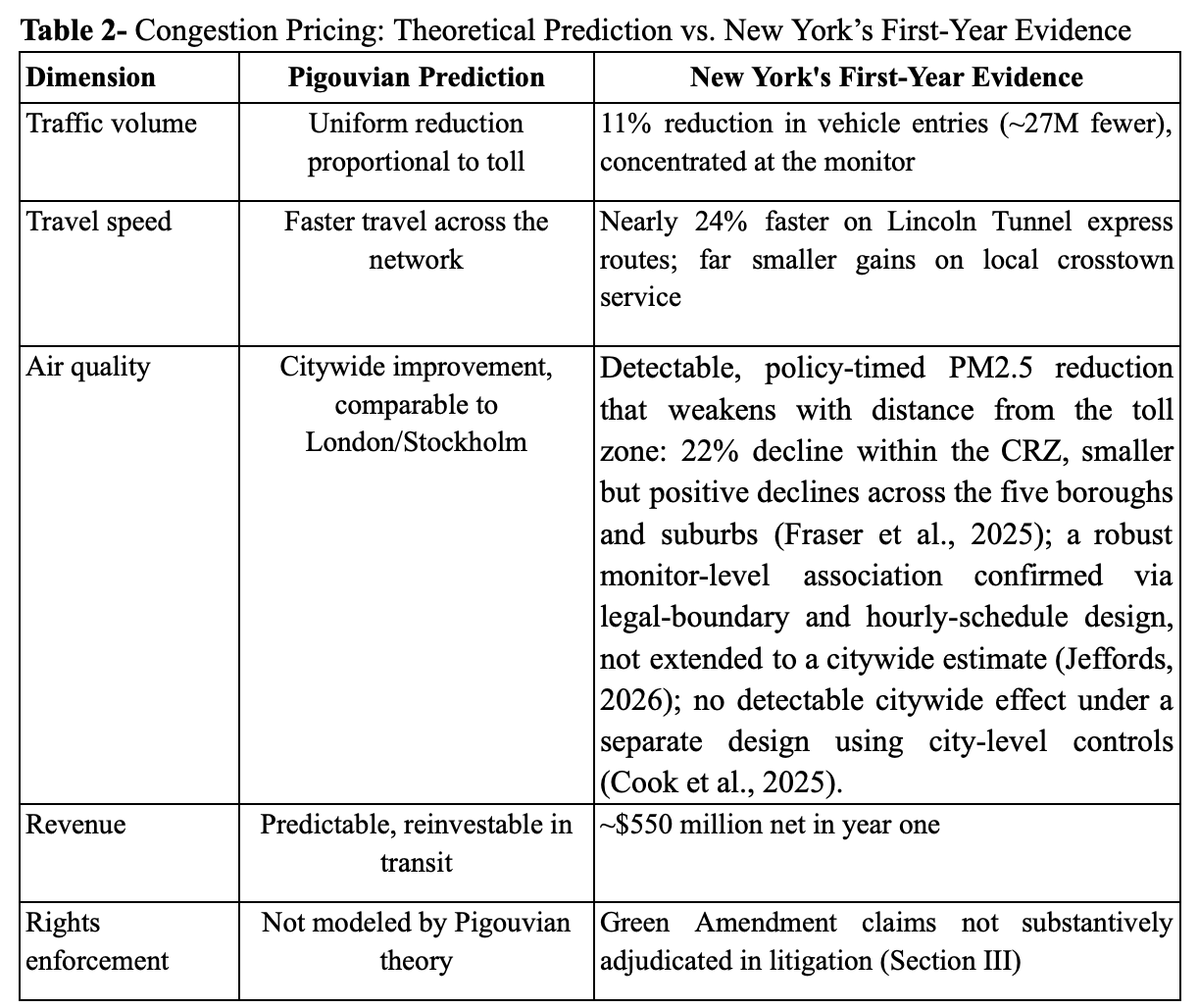
Note. Pigouvian predictions reflect the standard optimal-toll model developed in the text; New York evidence reflects first-year figures reported in the Introduction and Section IV. Air-quality evidence reflects conflicting monitor-level and citywide studies that differ in geographic scope rather than data quality.
Three of the table's four quantified metrics, traffic volume, travel speed, and revenue, fell within sufficiently tight margins for the toll to be considered functionally equivalent to Pigou's model. Air quality is the exception. Though Pigouvian theory predicted citywide benefits similar to what London and Stockholm experienced, NYC's first-year improvements were graduated rather than uniform: strongest near the toll zone, smaller but still measurable across the boroughs and suburbs, and undetectable in at least one citywide design, rather than the flat, dispersed gains recorded in London and Stockholm. This distinction matters beyond the air-quality data itself: the benefit tapers with distance from where the toll is priced, rather than reaching the full zone as the strength theory predicted, even though the toll applies citywide. This is the same kind of gap between what a mechanism promises on paper and what it actually delivers once implemented that this paper has traced through the Green Amendment's litigation record. Just as institutional capacity existed in New York's courts without the Green Amendment being enforced on its merits, the toll's pricing mechanism existed and functioned without producing the citywide air-quality gain the model predicts. This paper aims to diagnose that the same gap appears in the air-quality data, not to explain why it takes the specific shape it does. That same distinction between a mechanism's presence and its full delivery is what the table's final row makes explicit in a different way: Pigouvian theory has nothing to say about rights enforcement at all, so the Green Amendment's failure to clear the merits threshold cannot be read as a failed prediction the way air quality can. Instead, the two cases share the same underlying pattern. A mechanism can work cleanly on paper and still run into limits once it meets implementation, whether or not that mechanism was ever modeled well enough to predict the limit in advance.
V. Conclusion: Enforcement Cost as the Constraint on Institutional Capacity
This paper's central claim is that institutional capacity does not by itself determine whether a constitutional environmental right is enforced in practice; what determines this is enforcement cost, with Coase (1960) describing a right as valuable only to the extent that it can be accessed at a cost lower than the harm it protects against. New York's congestion pricing litigation provides the clearest test of that claim. Institutional capacity existed in spades there. The Green Amendment still failed to meet the threshold of substantive judicial engagement in four out of the 36 claims coded from across 12 cases. That gap, not its footnote, is this paper's main finding.
Section III measures this gap directly, through the codebook's claim-level record of what courts did, and did not, engage on the merits. Section IV applies the same basic framework to evidence on New York's first-year air-quality outcomes: a benefit that weakened with distance from the toll zone and vanished entirely under at least one citywide test, rather than the uniform, dispersed citywide gain the model predicted. Both interventions had and exercised their respective mechanisms, one a constitutional right and the other a Pigouvian price. Neither delivered their theoretically absolute potential once applied.
The same principle holds for a Pigouvian tax as for a constitutional right: a corrective fails when the cost to enforce it exceeds the cost of what it is supposed to price. The litigation surrounding New York's Green Amendment indicates that, here and in this place, that enforcement cost was great enough, or the substantive scope of the right uncertain enough, that courts bypassed rather than confronted it. It was not a lack of institutional capacity that tripped us up; it was the price of entry.
This claim would be falsified, and the central finding of this paper qualified to refer to narrower claims only, if some future court were substantively to reach the merits of a Green Amendment claim brought under Article I, § 19 of the New York State Constitution (whether over congestion pricing or some other dispute) and then to conclude that enforcement cost there is low after all. Absent such an outcome, the enforcement-cost gap this paper documents between the norm and these cases' rulings remains a binding constraint on the right, not merely an empirical pattern that happens to obtain in these situations. The upshot is not that we need better legal weapons. We need to use them.
The practical stakes of all of the aforementioned discussions are environmental, not just legal and economic. The Green Amendment in New York specifically exists to guarantee clean air and water. Nevertheless, NYC's eventual air-quality result came from regular politics and administrative law, not from someone successfully exercising the right draft for just this scenario. The environment is the central focus of this entire story, which is why this is just as much of an environmental problem as it is a legal or economic one: a citizen's air will not get cleaner just because their right exists on paper or because a court can hear their claim; it only gets cleaner when that ability is actually exercised to enforce the right. This problem will become more and more important as additional jurisdictions adopt constitutional environmental rights without tackling the reality of enforcing them: yes, institutional capacity can be (and should be) created, funded, and staffed, but until the price of enforcing these rights is lowered to a point where that capacity can actually be used to enforce the right it was intended to protect, that new capacity will remain sitting idle just as it does in New York.
Methods Appendix
Methods Appendix: Measuring Enforcement Cost Through Litigation Outcomes
This paper analyzes litigation outcomes as an observable proxy for the enforcement cost of a constitutional right, using Coase’s (1960) framing of a right’s value as contingent on the cost of enforcement. Two variables were coded for each claim: whether the courts reached merits (measure of enforcement of the CER), and the number of pages of legal description and analysis the courts devoted to the CER vs other legal reasoning (measures depth of enforcement).
Case Selection
I coded 12 cases involving litigation around NYC's congestion pricing. The Regional Plan Association/Tri-State Transportation Campaign compendium (n.d.) and Pace Law's environmental litigation repository (n.d.) served as the primary sources, with ample cross-checking against dockets to ensure precise reporting. Case coding reflects the docket as of July 13, 2026, the date of the most recent decision included in the census (Rockland; Neuhaus). In total, we coded 36 claims across the 12 cases, with one row per claim in Appendix A.
Merit-reached rule
We adhered to a hard-and-fast rule when analyzing the court documents and coding the claims made: a claim reached merits only if a court evaluated whether the underlying legal theory was actually violated. This excludes dismissals for lack of standing, mootness, or failure to state a claim (even with prejudice). To ensure correct and unbiased results, this rule was fixed before reading any cases.
Engagement-depth rule
Claims were coded by the number of pages of substantive analysis (i.e., analysis that applied the claim's legal standard to the facts of the case), as noted in the citing opinion, excluding any pages discussing procedural history or simply reiterating facts. If a judge's opinion analyzed two claims over the same span of pages, that page was double counted (once for each claim) and noted as shared in the codebook because the marginal costs of enforcing each of the two claims could not be separately observed. This variable was only used for claims for which the page range could be verified with the judge's underlying opinion. If page numbers could not be identified or located, the depth of engagement for the claim was not coded rather than providing a possibly incorrect estimate.
Verification
A second individual checked the coding of 25% of the claims directly from the primary documents to re-check the merits and the depth of engagement. The two coders agreed on 92% of items before resolving conflicts. We resolved the remaining conflicts by re-reading the text together.
Limitations
Coding court documents and claims revealed several constraints. First, the courts in these cases had single jurisdiction over a single policy, and their decisions and reasoning therefore cannot be generalized to the entire legal sector of environmental rights litigation. Second, engagement depth quantifies legal reasoning by counting pages of court documents, not by measuring substantive quality. Riders Alliance v. Hochul was originally miscoded as an edge case because its Green Amendment claim reached a motion to dismiss rather than being dismissed on the face of the complaint. Revisiting the underlying opinion clarified the confusion: the court discussed the Green Amendment only in the context of a one-page standing analysis. The opinion's primary holding involved a non-constitutional theory of law. The case was therefore relabeled NO under the merits-reached rule above with an engagement depth of one page, like every other case in the census.
Possible Explanations for the Litigation Pattern
The litigation outcomes here are a proxy for enforcement cost, not a definitive answer for why the counsels picked the claims they picked. A few explanations for the pattern in Section III seem possible and warrant further discussion. First, Article I, Section 19 is a young doctrine, only adopted in 2021, with little judicial guidance yet developed on what the standard actually requires. Counsel may reasonably view it as untested and risky relative to a doctrine like NEPA or the Commerce Clause, both of which carry decades of settled precedent. Second, litigants subject to page limits have every incentive to focus their strongest arguments on where precedent is clearest and most developed, rather than splitting that energy with an untested constitutional theory still increasing in acceptance. Third, there is a question of mootness: if you succeed on an alternative, primary theory of liability, think the NEPA and APA claims that went to the merits in this dataset, you will not need to plead the constitutional claim, and it might actually harm your plaintiff's case. Fourth, litigation strategy plays out over time. Institutionalized plaintiff groups that know how to fight in this space year after year (think: Riders Alliance) may be holding the claim for when they have a stronger fact pattern, rather than forcing the amendment to do unnecessary work too soon. The codebook cannot differentiate between these possibilities; it can only identify that one of them happened. To figure out which would require interviews with attorneys or access to internal litigation documents, and is beyond the scope of this paper. Even Coase (1960) only posited that enforcement costs were real and could limit rights, not what specifically causes them in individual cases. This paper is silent on the issue of mechanism in the same way that Coase was.
Appendix A
The table below is the claim-level dataset supporting Section III, focusing on Constitutional Environment Rights (CERs), and it does not provide a pure summary of legal briefs. In the table, one row translates to one claim, not one case, since cases span multiple rows. This table quantifies litigation outcomes to better and more accurately analyze enforcement costs of rights.
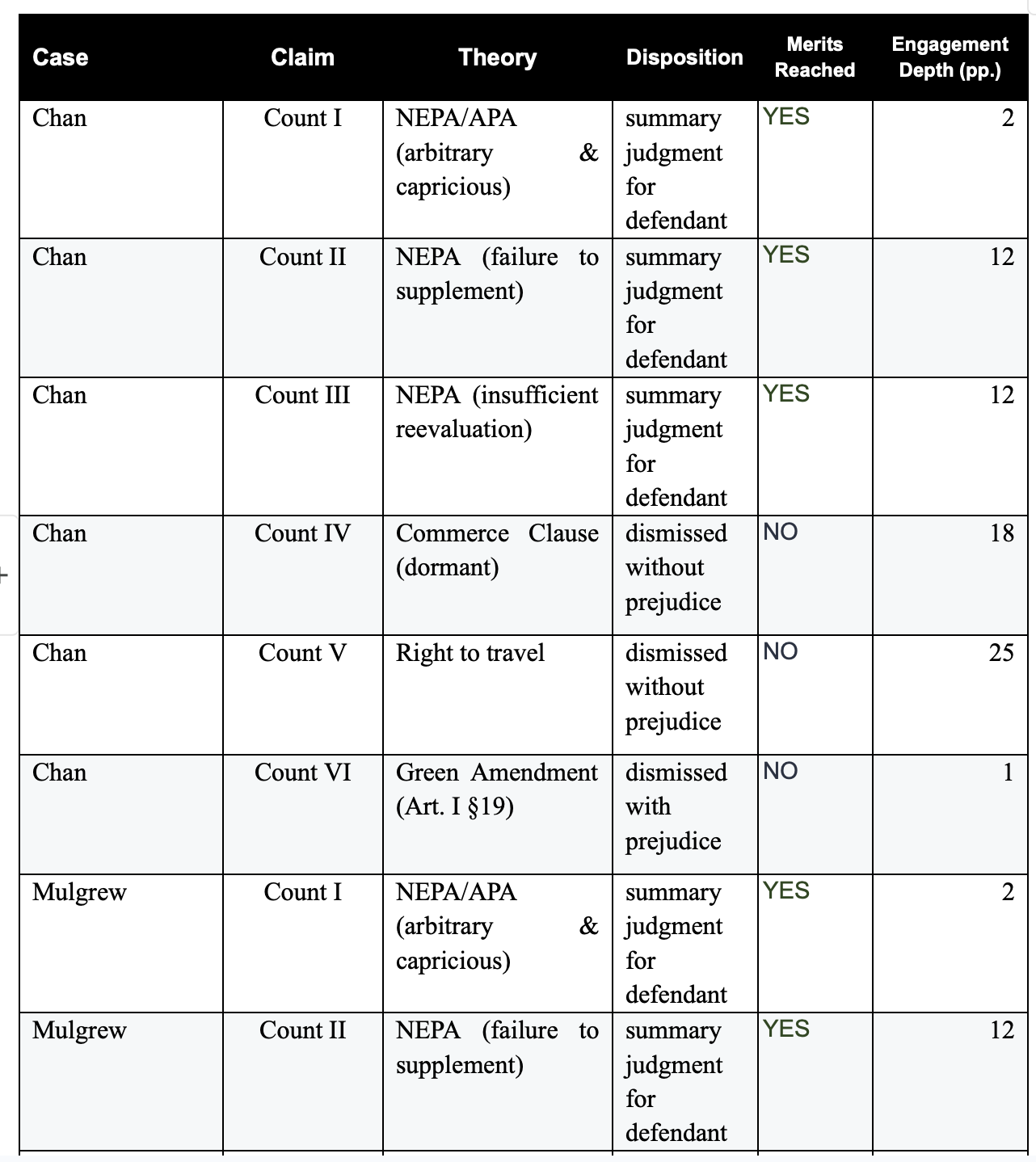
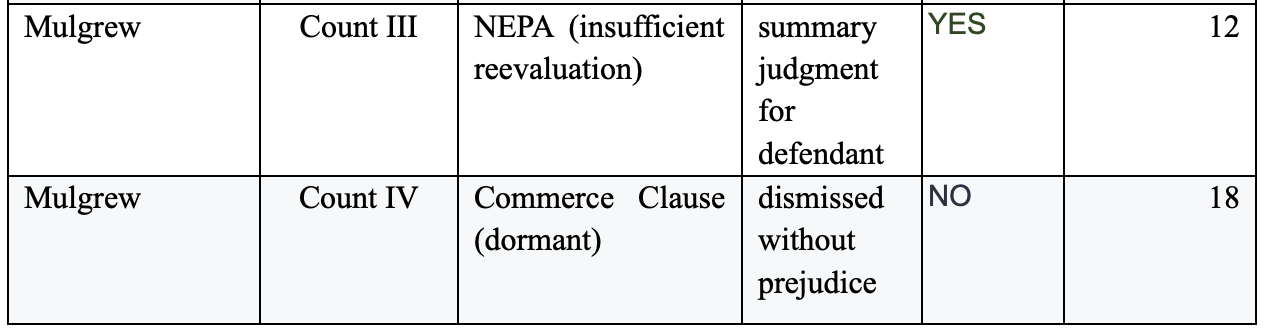
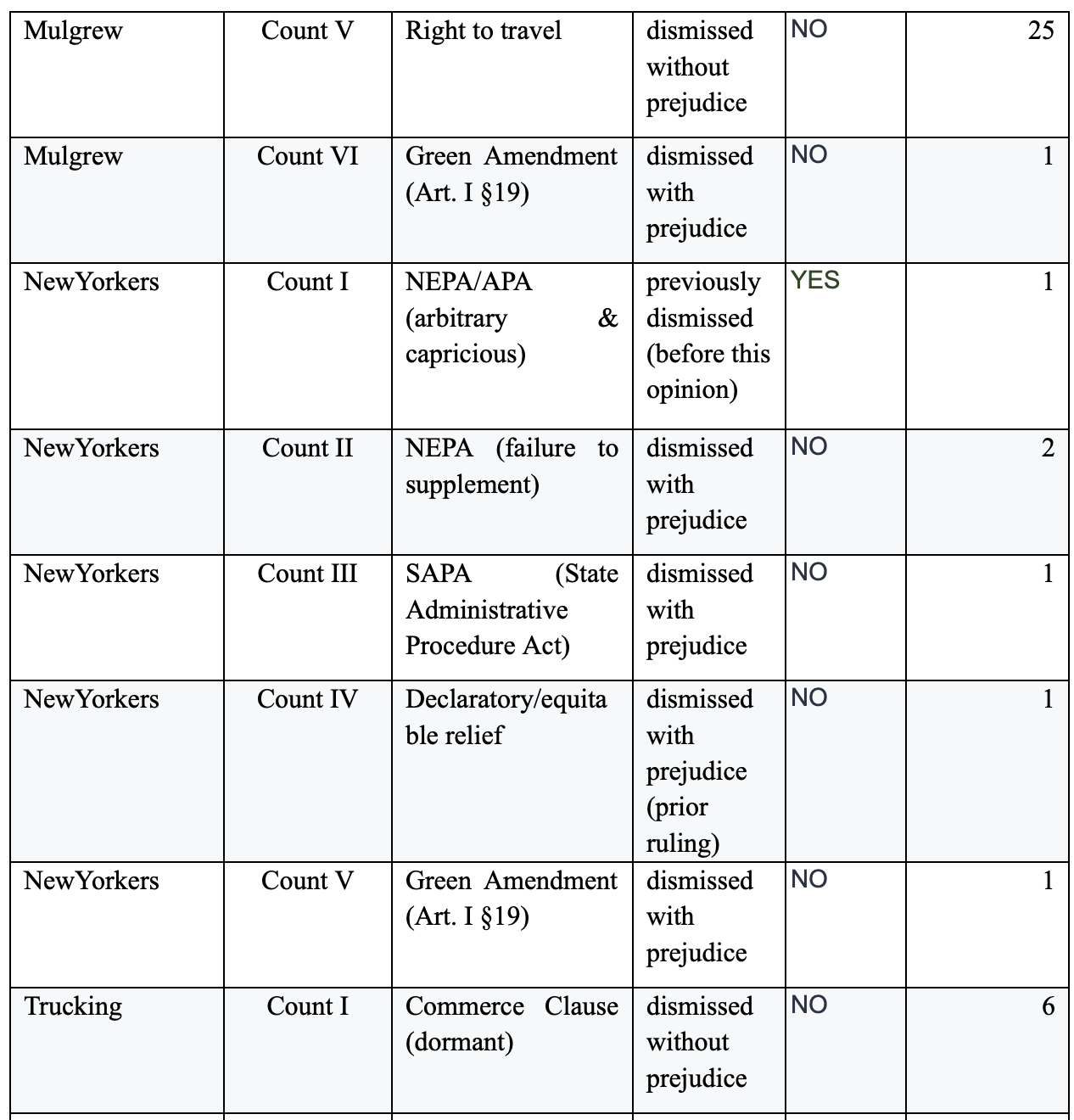
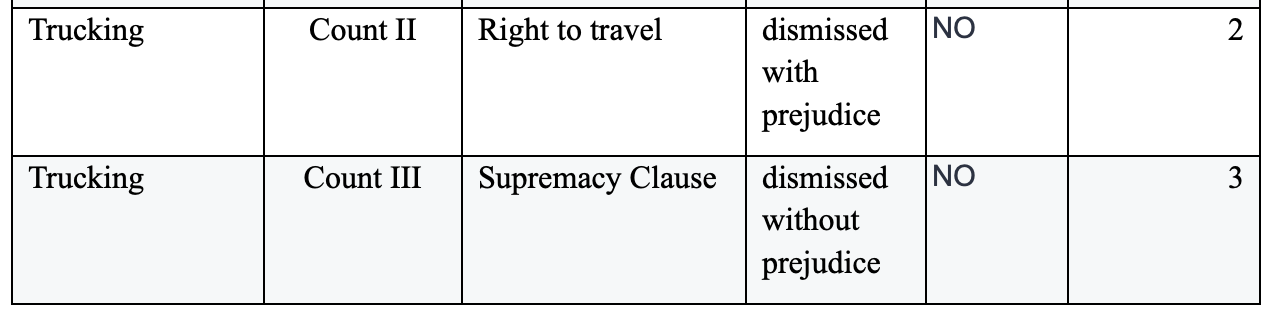
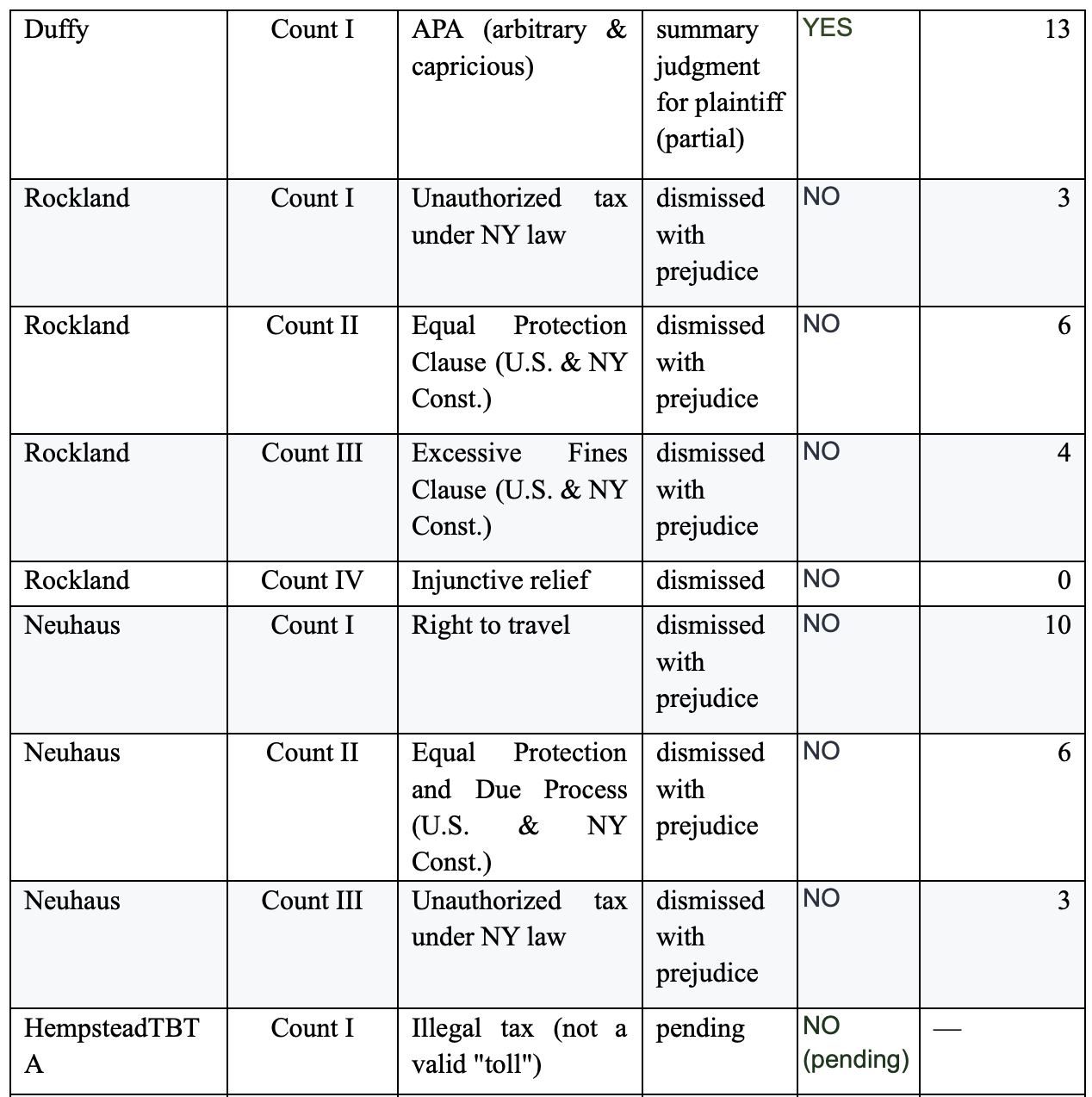
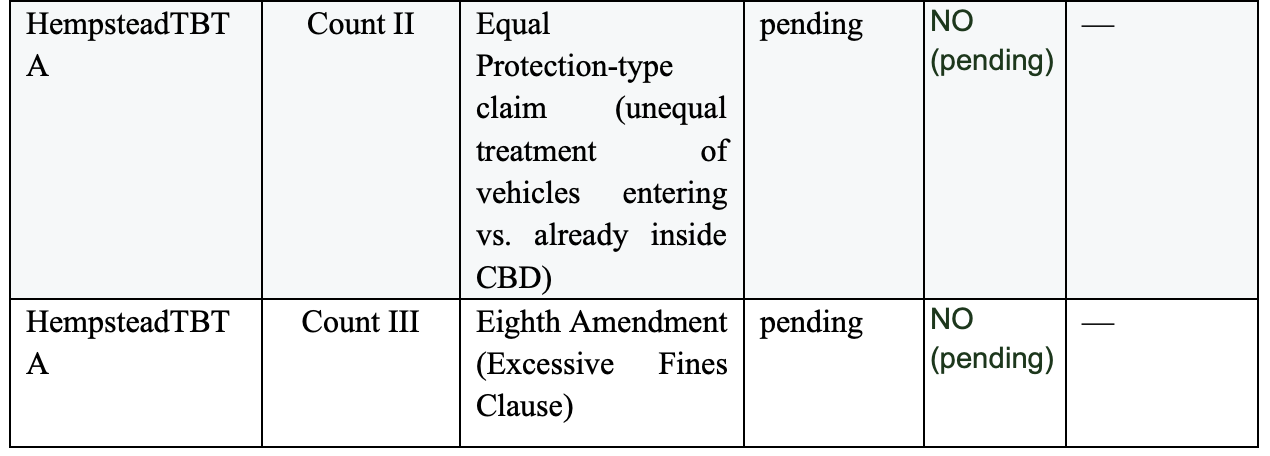
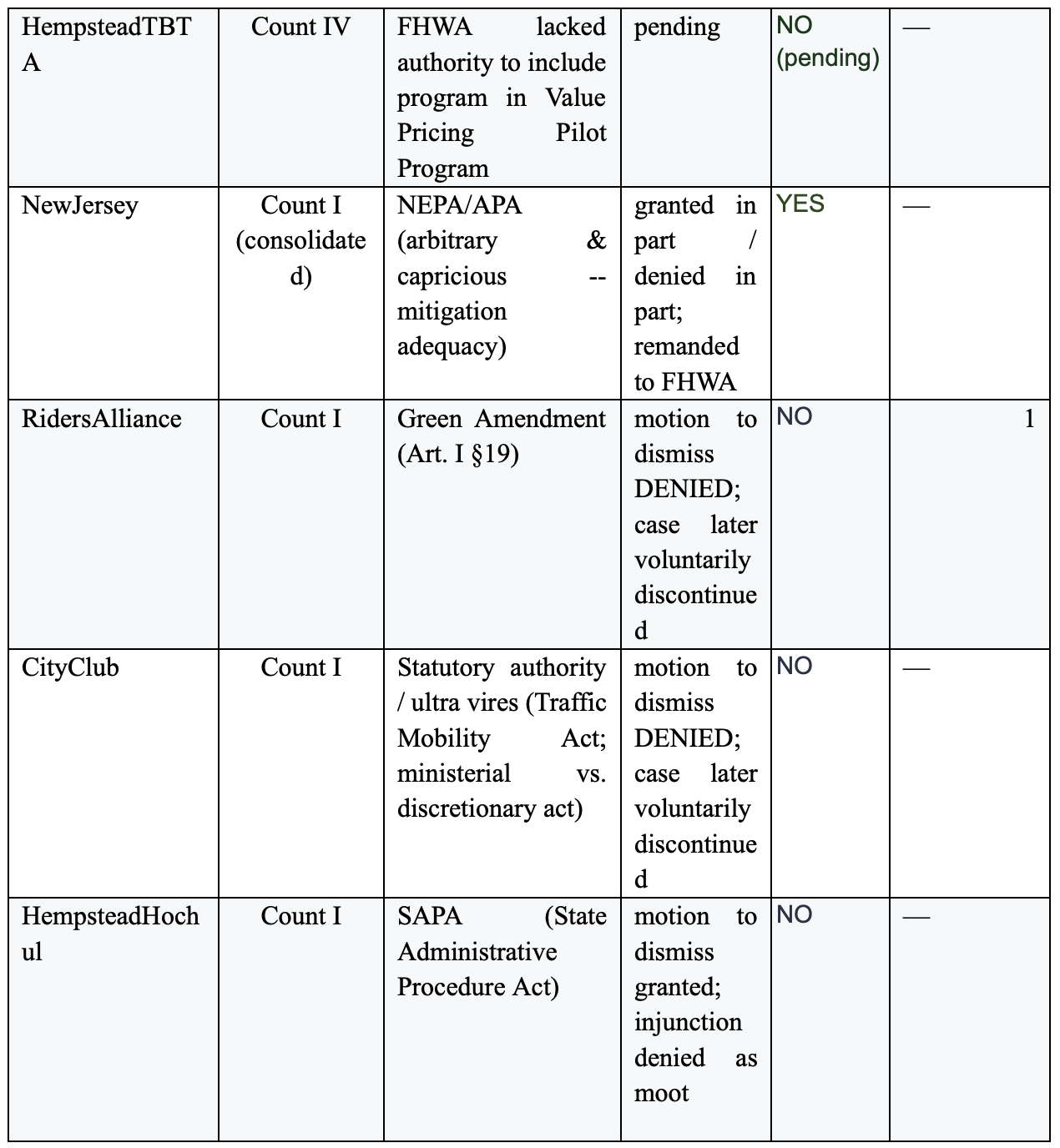
One row represents one claim. Multiple counts within a case result in multiple rows for that case. "Merits Reached" is determined by the rule listed in the Methods Appendix. If the Engagement Depth column contains an em dash (—), page range could not be verified from the opinion text provided (as opposed to no page range because no merits analysis was conducted). Hyperlinks to the full source for each coded claim are stored in the underlying codebook and they are available upon request.
References
Börjesson, M., Eliasson, J., Hugosson, M. B., & Brundell-Freij, K. (2012). The Stockholm
congestion charges—5 years on: Effects, acceptability and lessons learned. Transport
Policy, 20, 1–12. https://doi.org/10.1016/j.tranpol.2011.11.001
Boyd, D. R. (2012). The environmental rights revolution: A global study of constitutions,
human rights, and the environment. UBC Press.
CBS New York. (2025, January 5). NYC congestion pricing: New start date.
https://www.cbsnews.com/newyork/news/nyc-congestion-pricing-new-start-date/
Chan et al. v. USDOT et al., No. 23-cv-10365 (S.D.N.Y. Apr. 17, 2025) (Liman, J.).
The City Club of New York v. Hochul, Index No. 156696/2024 (N.Y. Sup. Ct. N.Y. Cnty.
Sept. 27, 2024) (Engoron, J.) (decided jointly with Riders Alliance).
Coase, R. H. (1960). The problem of social cost. Journal of Law and Economics, 3, 1–44.
Cook, C., Kreidieh, A., Vasserman, S., Allcott, H., Arora, N., van Sambeek, F., Tomkins, A.,
& Turkel, E. (2025). The short-run effects of congestion pricing in New York City
(NBER Working Paper No. 33584, revised January 2026). National Bureau of
Economic Research.
County of Rockland et al. v. TBTA et al., No. 7:24-cv-02285 (S.D.N.Y. July 14, 2025) (Seibel,
J.), aff'd, No. 25-1963 (2d Cir. July 13, 2026).
Eliasson, J., Hultkrantz, L., Nerhagen, L., & Rosqvist, L. S. (2009). The Stockholm
congestion-charging trial 2006: Overview of effects. Transportation Research Part A,
43(3), 240–250.Fraser, T., Park, Y. G., Lu, D., Tayarani, M., Deng, H., & Gao, H. O. (2025). A first look into congestion pricing in the United States: PM2.5 impacts after six months of New York
City cordon pricing. npj Clean Air, 1, Article 39.
https://doi.org/10.1038/s44407-025-00037-2
Gellers, J. C. (2017). The global emergence of constitutional environmental rights. Routledge.
Hardin, G. (1968). The tragedy of the commons. Science, 162(3859), 1243–1248.
Jeffords, C. (2016). On the temporal effects of static constitutional environmental rights
provisions on access to improved sanitation facilities and water sources. Journal of
Human Rights and the Environment, 7(1), 74–110.
Jeffords, C., & Minkler, L. (2016). Do constitutions matter? The effects of constitutional
environmental rights provisions on environmental outcomes. Kyklos, 69(2), 294–335.
https://doi.org/10.1111/kykl.12112
Jeffords, C. (2021). On the relationship between constitutional environmental human rights
and sustainable development outcomes. Ecological Economics, 186, Article 107049.
https://doi.org/10.1016/j.ecolecon.2021.107049
Jeffords, C. (2026). Congestion pricing and local PM2.5: Early evidence from fixed monitors
in New York City [Working paper]. SSRN. https://ssrn.com/abstract=7016078
Leape, J. (2006). The London congestion charge. Journal of Economic Perspectives, 20(4),
157–176.
Mass Transit. (2024, November 14). Congestion pricing to be implemented in New York City
starting January 2025. https://www.masstransitmag.com/technology/fare-collection/art
icle/55243322/congestion-pricing-to-be-implemented-in-new-york-city-starting-january-2025
Metropolitan Transportation Authority. (2025, July). ICYMI: Six months, Governor Hochul
highlights success of congestion pricing traffic [Press release]. https://www.mta.info/pr
ess-release/icymi-six-months-governor-hochul-highlights-success-of-congestion-pricin
G-traffic
MTA v. Duffy, No. 25-cv-1413 (S.D.N.Y. Mar. 3, 2026) (Liman, J.).
Mulgrew et al. v. USDOT et al., No. 24-cv-1644 (S.D.N.Y. Apr. 17, 2025) (Liman, J.)
(resolved jointly with Chan).
Neuhaus v. TBTA et al., No. 7:24-cv-03983 (S.D.N.Y. July 14, 2025) (Seibel, J.), aff'd, No.
25-1964 (2d Cir. July 13, 2026).
New Jersey v. USDOT et al., No. 2:23-cv-03885 (D.N.J. Dec. 30, 2024) (Gordon, J.).
New York State Governor's Office. (2024, June 5). What they are saying: Governor Hochul
announces pause on congestion pricing to address rising costs [Press release]. https://
www.governor.ny.gov/news/what-they-are-saying-governor-hochul-announces-pause-
Congestion-pricing-address-rising
New York State Governor's Office. (2026, January 5). Less traffic, better transit: It is first
anniversary, Governor Hochul celebrates transformational congestion pricing
program [Press release]. https://www.governor.ny.gov/news/less-traffic-better-transit-i
Ts-first-anniversary-governor-hochul-celebrates-transformational
New Yorkers Against Congestion Pricing Tax et al. v. USDOT et al., No. 24-cv-367 (S.D.N.Y.
Apr. 17, 2025) (Liman, J.) (resolved jointly with Chan).
Ostrom, E. (1990). Governing the commons: The evolution of institutions for collective action.
Cambridge University Press.
Pace University, Elisabeth Haub School of Law. (n.d.). Environmental litigation repository.
Pigou, A. C. (1920). The economics of welfare. Macmillan.
Regional Plan Association. (n.d.). NYC congestion pricing litigation compendium. Retrieved
September 11, 2025, from rpa.org
Riders Alliance v. Hochul, Index No. 156711/2024 (N.Y. Sup. Ct., N.Y. Cnty., Sept. 27, 2024)
(Engoron, J.).
Town of Hempstead et al. v. Hochul, No. 24-CV-08121 (E.D.N.Y. removed Nov. 21, 2024).
Town of Hempstead v. TBTA, No. 2:24-cv-03263 (E.D.N.Y. filed May 1, 2024).
Transport for London. (2007). Central London congestion charging: Fifth annual report.
Transport for London.
Trucking Association of New York v. MTA et al., No. 24-cv-4111 (S.D.N.Y. Apr. 17, 2025)
(Liman, J.) (resolved jointly with Chan).
Vickrey, W. (1969). Congestion theory and transport investment. American Economic Review,
59(2), 251–260.
Walters, A. A. (1961). The theory and measurement of private and social cost of highway
congestion. Econometrica, 29(4), 676–699.