Known Costs, Speculative Benefits: A Net Economic Baseline for Netflix's Fort Monmouth Studio in Monmouth County, New Jersey
Contributors: Daniel Macedo, Ryan Narov, Sophia Djoulia, and Aksel Tabak
Abstract
This paper examines whether the gross economic benefits attributed to Netflix's $1 billion studio at Fort Monmouth survive once public subsidy costs, spending leakage, and fiscal mismatch are netted out. Building on North's export-base theory, which treats the studio's global content revenue as the basic sector recirculating through Monmouth County's local economy, and on a gross-versus-net accounting framework that nets total economic activity generated against the cost of public subsidies, spending leakage, and displacement of existing activity, this paper argues that the two sides of the ledger are not symmetrical in how well they can be known: the public cost is contractual, front-loaded, and precisely knowable today, while the benefits are projected, back-loaded, contingent on institutions that do not yet operate at the required scale, and knowable only as ranges. Because the studio does not open until 2027 at the earliest, the paper does not measure realized impact; it establishes a documented baseline through three original analyses. A milestone-sequenced difference-in-differences comparison of Zillow Home Value Index growth across ten Monmouth County ZIP codes finds a full-post near-far gap of 3.62 percentage points against a pre-announcement gap of 4.07 points and a placebo gap of 3.43 points, so the estimate functions as an upper bound rather than a clean causal effect, and is far smaller than the 9.3% raw appreciation figure circulating in local coverage. A benchmark against Slattery and Zidar puts the Aspire award at about $258,000 per promised job, 2.17 times the $118,667 national average, inverting that literature's expectation that wealthier jurisdictions pay less. A projection of credential output from the New Jersey Film Academy at Brookdale Community College finds the county pipeline covering roughly 16.5% of craft-credentialed demand at opening, a shortfall that ranges from 9.9% to 24.7% across assumptions. Together these findings indicate that the studio's public cost is already known and substantial, while its promised return depends on a workforce pipeline and a local spending capture rate that are not yet in place.
Introduction
Fort Monmouth served as a United States Army installation from 1917 to 2011. After its closure, it sat vacant for around a decade, an economic blow to the region. Now, Netflix is redeveloping it. After being selected as redeveloper in December 2022, closing on the property in December 2025, and committing to invest one billion dollars, Netflix will transform the 292-acre former Army installation into a premier East Coast production hub with twelve soundstages totaling nearly 500,000 square feet, one of the largest private investments in county history and the anchor of New Jersey's bid to become "Hollywood East." To what extent does Netflix's establishment in Monmouth County affect the local economy? This piece examines Netflix's projected impact across five sections: employment and labor market, real estate and infrastructure, consumer spending and local business impact, tax revenue and government finances, and innovation and long-term effect.
Within these sections, the paper reports three original analyses: a milestone-sequenced test of whether local home values have capitalized the studio, a benchmark of the public subsidy against comparable deals in the incentive literature, and an assessment of whether the regional workforce training pipeline can supply the promised jobs. Throughout, the analysis is grounded in two lenses: export-base theory, which holds that regional growth is driven by an outside-facing "basic" sector that brings new money into a local economy (here, Netflix's global content revenue), recirculating through the county's non-basic, local economy; and a gross-versus-net framework, which distinguishes total economic activity generated from that activity minus the cost of public subsidies, spending leakage, and displacement of existing economic activity.
This paper asks whether the gross economic benefits of Netflix's Fort Monmouth studio survive once public subsidies, spending leakage, and fiscal mismatch are accounted for. Its central claim is that the two sides of that ledger are not symmetrical in how well they can be known: the public cost is contractual, front-loaded, and precisely knowable today, while the benefits are projected, back-loaded, contingent on institutions that do not yet operate at the required scale, and knowable only as ranges. Because the studio does not open until 2027 at the earliest, this paper does not claim to measure its impact; it measures what is observable now and establishes a documented baseline against which the studio's actual effects can be assessed once it operates. While Netflix's Fort Monmouth project has drawn extensive coverage from local and regional news outlets, no academic study to date has quantified its net, rather than gross, economic impact on Monmouth County; this paper aims to fill that gap.
Literature Review
Scholarly research directly on this question is thin, but several larger bodies of theory connect. North (1955) and Tiebout (1956) introduced the debate on export-base theory; North argued that localities grow by exporting goods to outsiders via comparative advantage-led outside demand, while Tiebout believed local spending alone drives growth and criticized "export" for relying on arbitrary definitions of regions. This paper approaches the question from North's viewpoint: assuming Netflix's studio behaves as an export-based firm, the Employment section analyzes its impact by deriving employment multipliers, and the Tax section applies a but-for test.
Input-output and multiplier theory, developed by Leontief (1936) and later refined by Miller and Blair and by the U.S. Bureau of Economic Analysis, modeled how one industry's outputs become another industry's inputs, deriving multipliers mathematically and distinguishing between direct, indirect, and induced effects. The BEA's guide to its own program, RIMS II, explains that methodology further and warns against overstating effects; the Tax section uses a similarly constrained but-for test, while the Limitations section takes up that warning along with other scholars' advice against ignoring capacity constraints. Building on this literature, Moretti (2010) estimated that each export-sector job creates another 1.6 jobs on average; under this logic, a 1,500-person facility would generate roughly 2,400 additional jobs and about 3,900 jobs in total (1,500 direct plus 1,500 multiplied by 1.6), not 1,500 multiplied by 1.6. Moretti's (2012) subsequent research differentiated between high-multiplier industries like technology, which enjoy stronger local economic benefits, and low-multiplier industries like retail; the Employment section uses Moretti's implied multiplier to bound the studio's expected secondary employment impact, not to declare it.
Rosen (1974) and Roback (1982) analyze local price inflation as a byproduct of implicit amenities. Rosen was the father of hedonic pricing models, which explained that when buying a house's finite square footage, buyers also buy a bundle of local implicit amenities. Rosen showed the value of these amenities could be teased out from total sale prices observed in the market. Roback expanded Rosen's housing model to include labor supply and demand across an entire city, formalizing an equilibrium between the local amenities businesses move for and the jobs workers commute to. Fort Monmouth had been vacant for over a decade by the announcement of the Netflix deal, despite sitting for years as the centerpiece of redevelopment plans that never broke ground; it had not been built yet, so announcing the studio was effectively a probabilistic claim on the area's future implicit amenities. This suggests any price increases will accrue as the market's confidence in the project's completion grows. Study 1 in the Real Estate section attempts to measure that directly, using a string of project milestones which reduced its risk of non-completion over time.
Each piece of literature discussed on subsidy and incentives informed some portion of the Tax section. Bartik (1991) argued that subsidies must cause an economic event to work, and is also responsible for popularizing deadweight loss. Slattery and Zidar (2020) found that the average discretionary subsidy deal was valued at $178 million for 1,500 jobs, noting that these deals often award money for more jobs than are ultimately created, and found no relationship between industry-targeted incentives and job growth, regardless of whether the incentives were big or small. Thom's (2018) research on a similar motion picture incentive program adopted by many states found that transferable film tax credits led to higher employment in that industry, though not to higher wages or GDP, prompting researchers to question whether they even pay for themselves. States have started auditing themselves to find out: in 2024, an outside firm published one of several state audits of film tax credit programs; New York's found that for every dollar spent, the program returned just $0.31 in state tax revenue (PFM Group Consulting). Taken together, these papers explain why the Tax section compares the worth of the $387 million Aspire incentive to Slattery and Zidar's $178 million.
Finally, the literature on clustering and growth poles, including Marshall (1890), Krugman (1991), Porter (1998), Perroux (1955), and Darwent (1969), allowed for a growth-pole-theory-informed discussion of "Hollywood East." Marshall identified three sources of knowledge spillover (labor force sharing, supplier sharing, and simply working in the same industry) as causes for firms to cluster, but warned cities that they would become too dependent on one industry if they did. Krugman modeled this phenomenon with his core-periphery model, which demonstrated firms will cluster around large markets even with competition, and once started, positive feedback loops could drive more clustering than any neoclassical model would consider "optimal." Porter applied these ideas explicitly to Hollywood: clusters increase individual firms' productivity by allowing specialization, increasing innovation, and creating incubators that new firms want to join. Additionally, he argued states should coax cluster formation rather than bid against each other with incentives for firms already inclined to cluster.
Growth pole theory, developed separately by Perroux (1955) and later by Darwent (1969), theorized that a "dominant" firm of regional scale would generate peripheral growth around it. Drawing parallels between the existing Hollywood cluster and Fort Monmouth's proposed studio, growth pole theory similarly predicts common causes of failure: a dominant firm doesn't hire locally, doesn't source supplies from external firms, or doesn't plan to stay long, so the growth pole never takes hold. Growth pole theory, and similar cases of a filmmaking hub hollowing out, like Fort Lee after filmmakers left the East Coast for Hollywood in the 1910s, inspired the Innovation section's anchor versus cluster framework, while Marshall's shared-labor-pool condition specifically is what Study 3 empirically tests.
Methods and Limitations
This paper reports three original analyses. All use publicly available data and are reproducible from the sources and procedures described below.
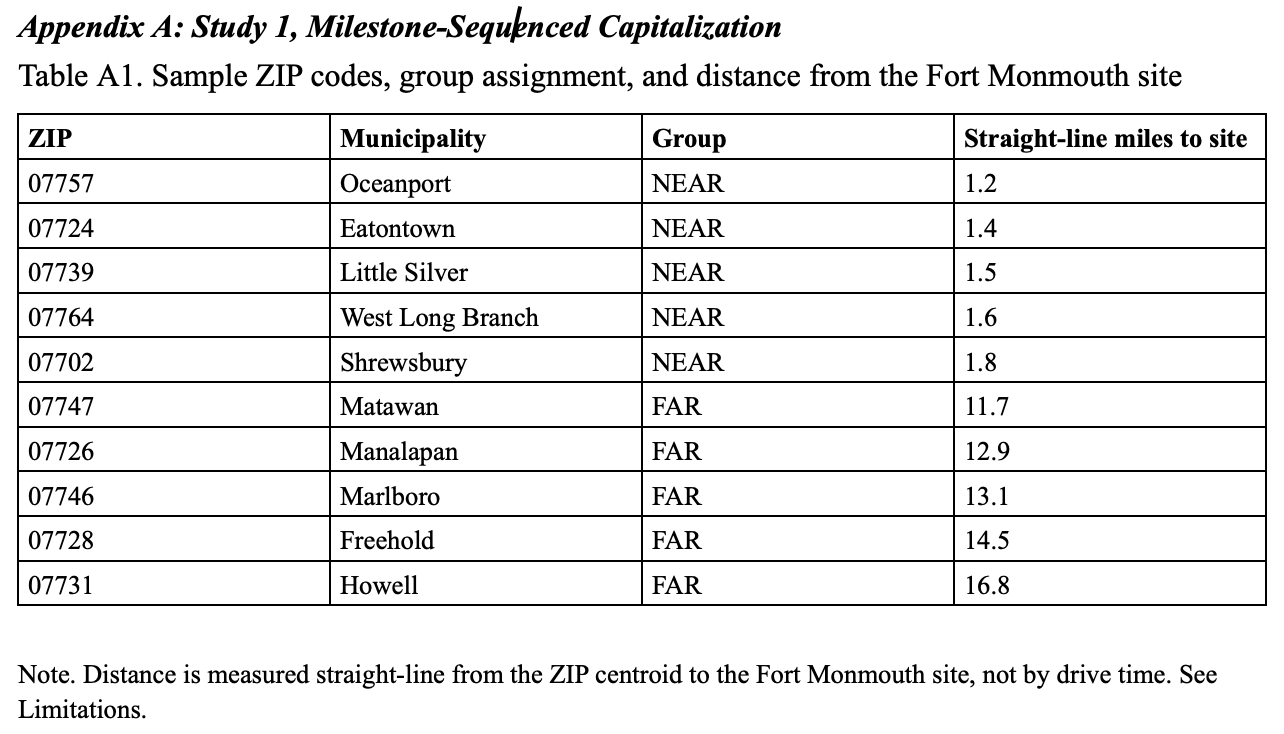
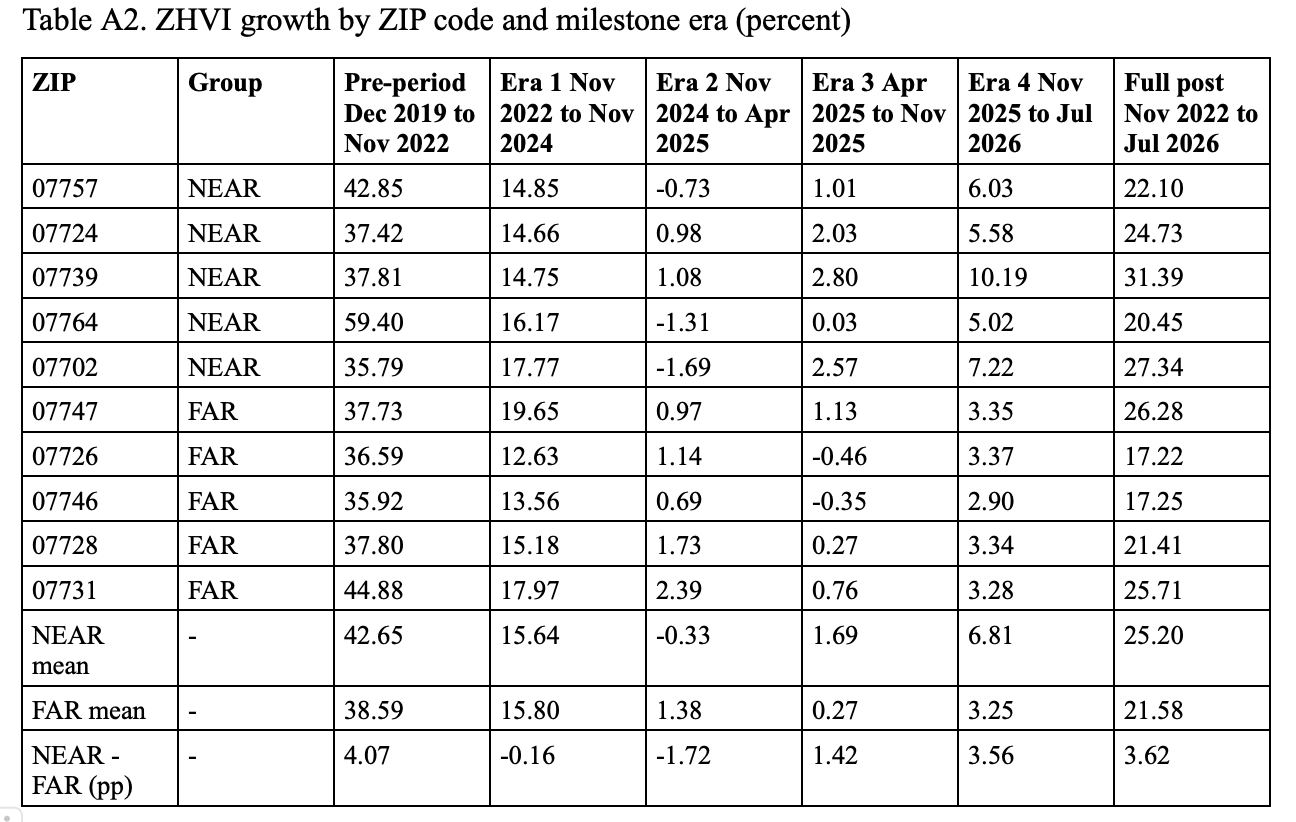
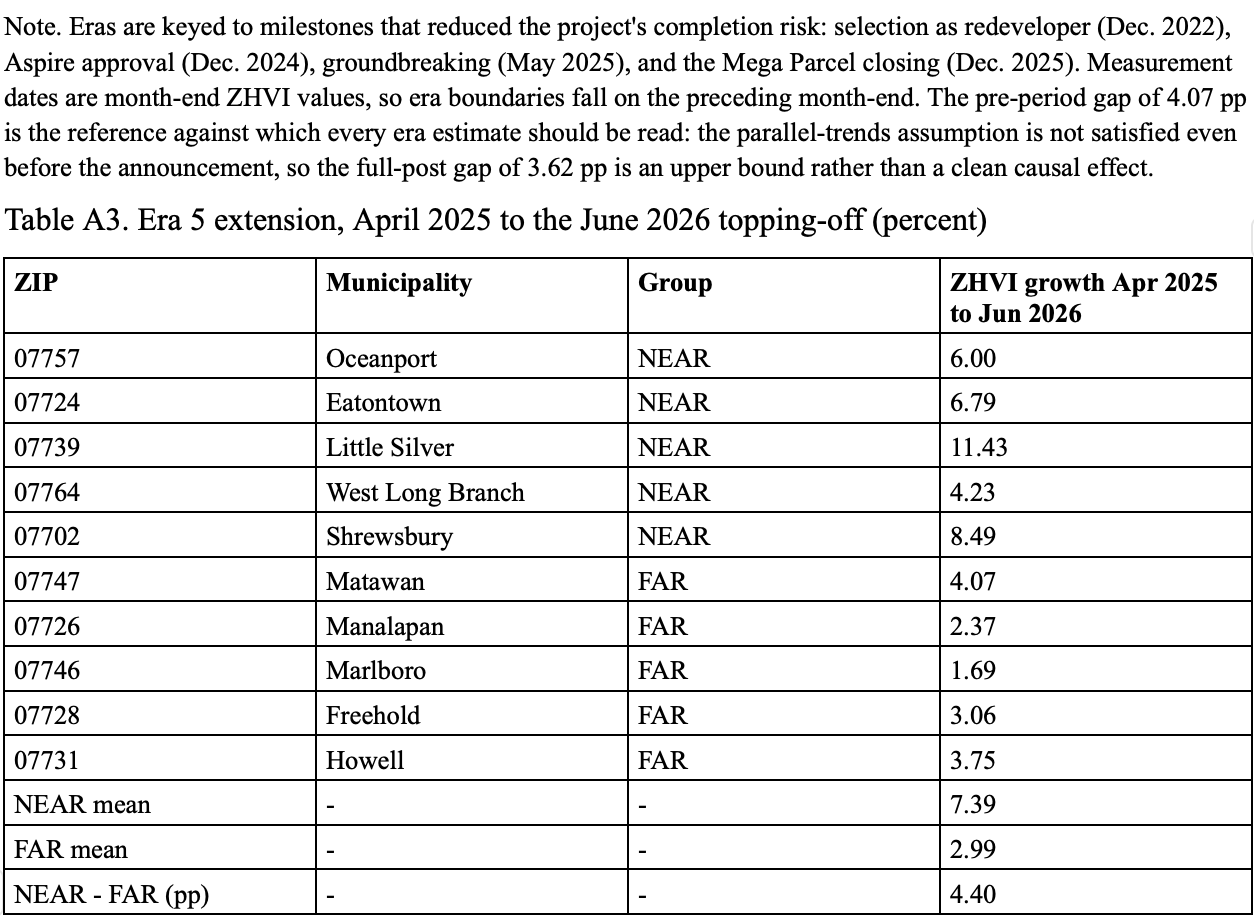
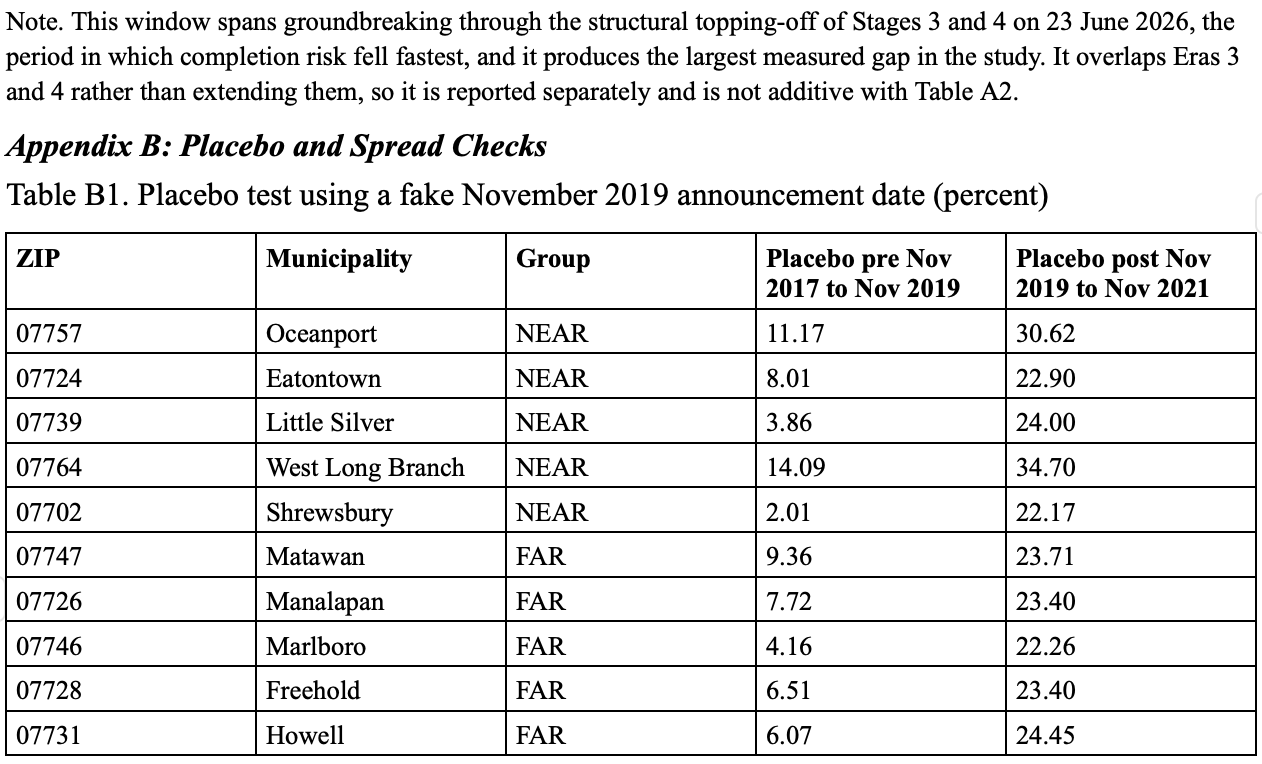
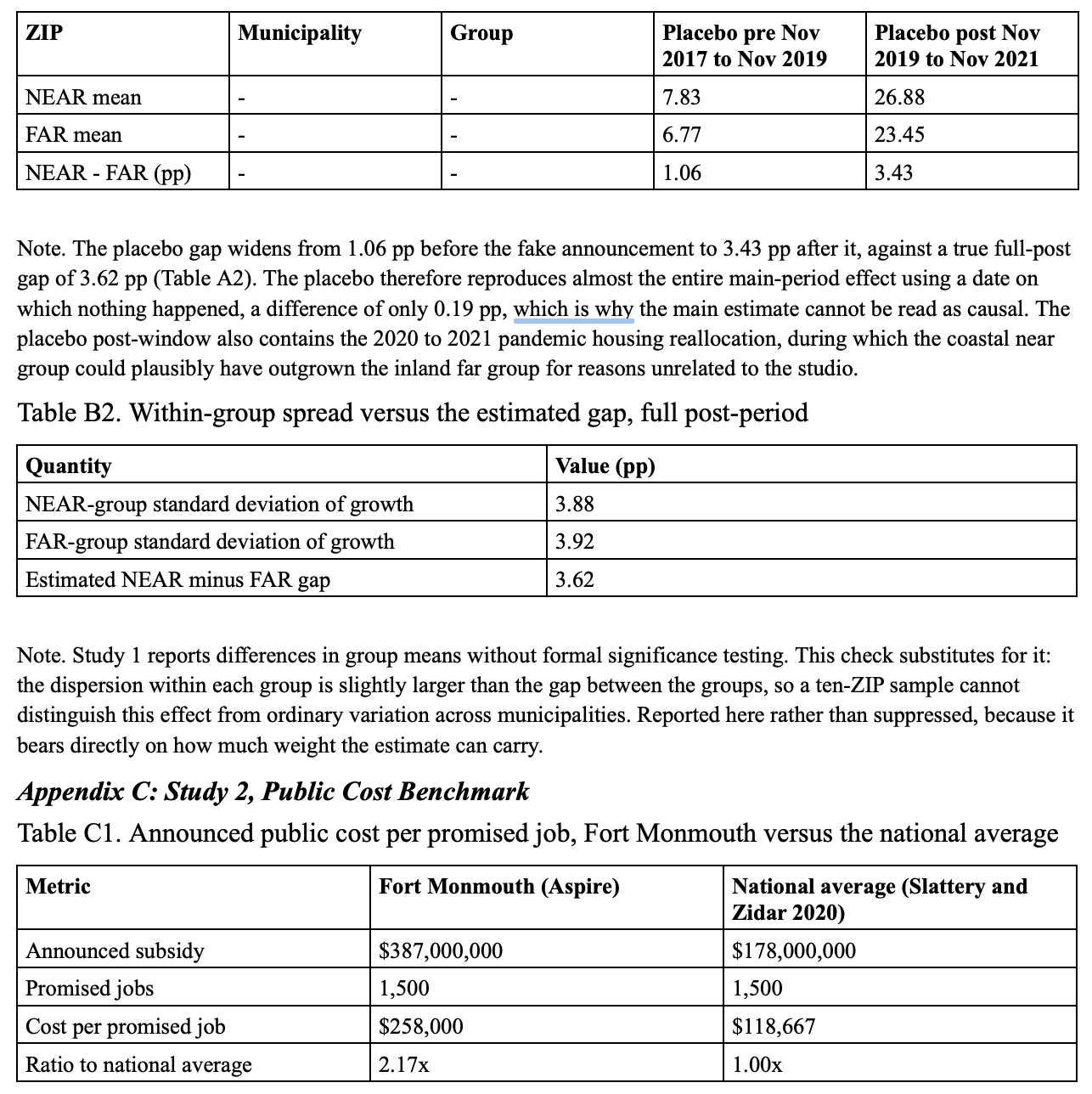
Study 1 (Milestone-Sequenced Capitalization) is a difference-in-differences comparison of Zillow Home Value Index (ZHVI) growth between five ZIP codes near the Fort Monmouth site (07757, 07724, 07764, 07739, 07702) and five comparable ZIP codes eleven to seventeen miles away (07746, 07747, 07728, 07731, 07726), computed separately across a pre-announcement window and four eras defined by milestones that resolved the project's completion risk: selection as redeveloper (December 2022), Aspire approval (December 2024), groundbreaking (May 2025), and the Mega Parcel closing (December 2025), with a fifth era added where data allow, keyed to the June 2026 structural topping-off. ZHVI, a weighted average of home values between the 35th and 65th percentiles, was chosen over median sale price because it is less sensitive to compositional change in which sales happen to occur in a given month. The pre-announcement near-far gap is 4.07 percentage points, meaning the parallel-trends assumption is not fully satisfied even before the announcement, so the milestone-era estimates should be read against this baseline. A placebo test using a fake November 2019 announcement date returns a 3.43-point gap against a main-period gap of 3.62 points, close enough that the placebo cannot be read as reassuring; the placebo window also contains the 2020 to 2021 pandemic housing reallocation, during which the coastal near group could have appreciated faster than the inland far group for reasons unrelated to the studio. Appendix A includes full ZIP-level results.
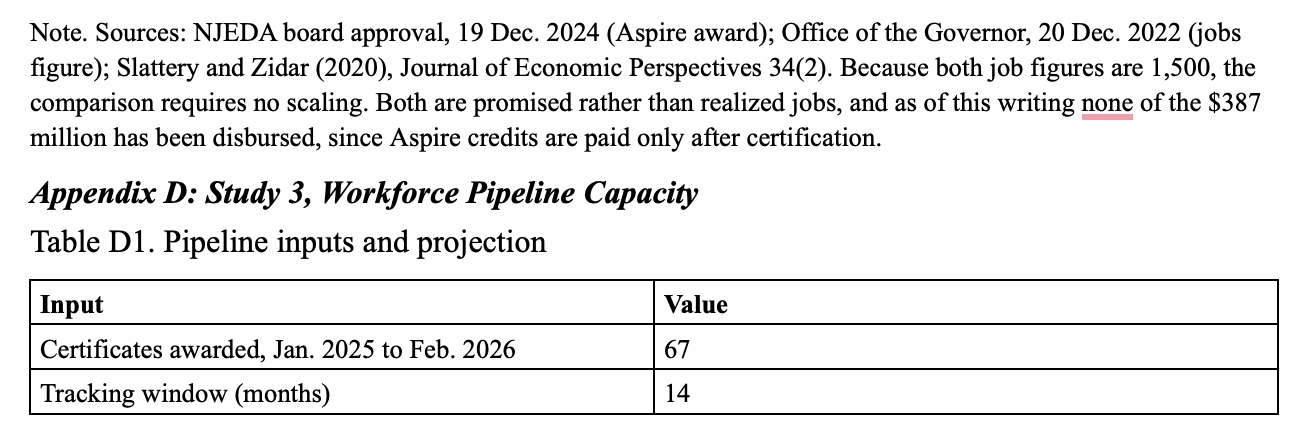
Study 2 (Public Cost Benchmark) compares the announced Aspire award against Slattery and Zidar's national average of $178 million per 1,500 promised jobs. Because Netflix's own promised-jobs figure is likewise 1,500, the comparison requires no scaling. No benefit-cost ratio is computed, since doing so would require projecting two decades of tax receipts and selecting a discount rate and a but-for share, a chain of unobservable assumptions each capable of altering the result by a factor of two.
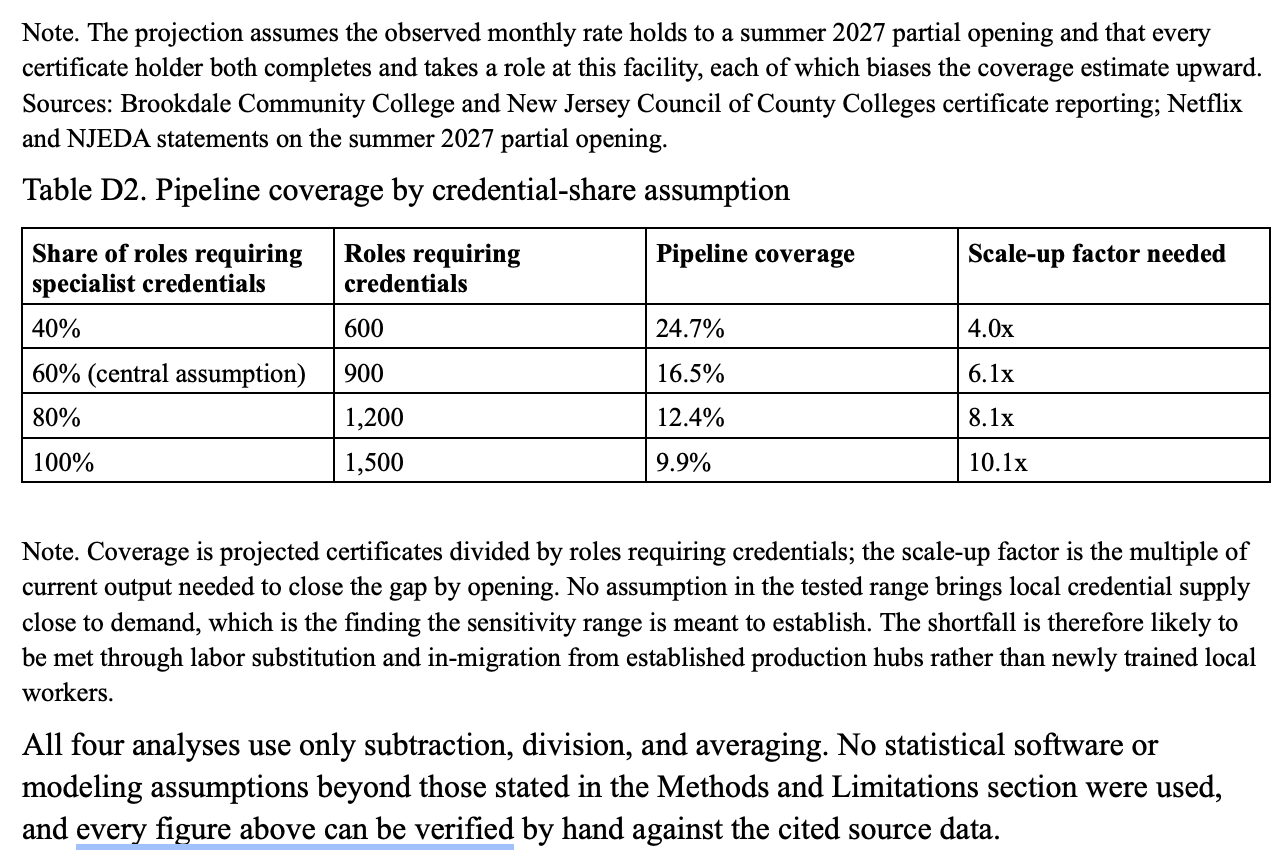
Study 3 (Workforce Pipeline Capacity) projects credential output from the New Jersey Film Academy at Brookdale Community College (67 certificates awarded January 2025 to February 2026, roughly 4.8 per month) forward to a summer 2027 opening, yielding about 148 certificates, and compares that against the share of 1,500 promised roles assumed to require specialist credentials, reported across a 40% to 100% sensitivity range.
Limitations. The studio is not operating, so this paper measures anticipation rather than realized impact. Study 1 reports differences in group means without formal significance testing, instead checking against within-group spread, which is comparable in size to the estimated gap; its ten-ZIP sample cannot detect small effects, and ZHVI is a modeled, revised estimate rather than a transaction record. Distance is measured straight-line rather than by drive time; ZIP codes do not correspond to true housing submarkets, and the pandemic confounds the placebo window. The fiscal comparison uses promised rather than realized jobs, and no observable local spending-capture rate exists for this facility, so consumer-spending effects are not estimated in dollar terms.
Employment and Labor Market Effects
Netflix's studio will create jobs through direct, indirect, and induced employment. Netflix projected the studio will directly generate up to "1500 permanent production jobs and more than 3500 construction related jobs in New Jersey" (Netflix, "Governor Murphy"), later describing the project as a $1 billion investment (Netflix, "Breaking Ground"). While local coverage often sums these into a single 5,000-job headline, rigorous tracking separates the 3,500 short-term construction positions from the 1,500 long-term operational roles. Governor Phil Murphy stated the Aspire approval "will help create thousands of good-paying jobs, support small businesses and vendors, and stimulate the regional economy" (New Jersey Economic Development Authority).
Indirect employment is expected among suppliers and contractors, including construction firms, equipment rental companies, and caterers; Netflix has stated it has "actively participated in various community-focused events...to connect with local vendors" (Netflix, "Breaking Ground"). While some industry commentary claims 3,000 to 4,000 indirect jobs, this paper applies Moretti's local multiplier of 1.6 spillover jobs per export-sector job to the 1,500 permanent figure, implying roughly 2,400 additional jobs and about 3,900 jobs in total, were the full 1,500 realized and all of them net additions. Both conditions are uncertain: the facility does not open until 2027, Moretti's multiplier was estimated across metropolitan labor markets rather than a single facility of this scale, and a job filled by a worker relocating from New York is not a net addition to the regional labor market. This estimate is lower than the 3,000 to 4,000 figure sometimes cited locally, suggesting promotional claims did not fully account for real-world local labor-market leakage. Senator Vin Gopal, who hosted a meeting between Netflix executives, local businesses, and labor unions, relayed that a Netflix executive assured attendees the studio would bring significant revenue to small, family-owned businesses; Gopal summarized, "a studio is a small town, and we have small-town needs" (Gopal).
Induced employment is expected as new spending circulates through the broader economy. Governor Murphy stated the investment would "spark an entirely new ecosystem of housing, hotels, and ancillary businesses and services, bringing with it countless additional jobs" (Office of the Governor). The Motion Picture Association reports New Jersey's film industry has generated $2.15 billion and 19,000 jobs since 2020 (New Jersey Business Magazine, "NJ's Film Industry"). However, political press releases citing $3.8 to $4.6 billion in regional impact represent optimistic gross targets rather than discounted net impacts.
Long-term, Brookdale Community College launched the New Jersey Film Academy in response to Netflix's expansion, with its president stating the goal is "to build a pipeline of skilled talent to support the influx of major film and TV productions coming to New Jersey" (Two River Times, "Brookdale"). Brookdale offers tracks in On Set Production, Production Office and Accounting, and Hair, Makeup, and Wardrobe. Still, some roles may not be filled locally, rising labor demand may raise housing costs, and some positions likely represent relocation from established New York or northern New Jersey production hubs rather than net new job creation; Study 3 tests this concern directly.
The first evidence of actual, rather than promised, hiring appeared on February 23, 2026, when Netflix posted its first operational role: Director of Studio Operations, salaried $420,000 to $790,000. This is a useful real data point, but it is a senior corporate role, not one of the craft positions the Study 3 pipeline is built to measure; if early hiring continues to skew toward relocating industry professionals in high-level roles, that would be consistent with this paper's broader finding that the credential gap is likely to be filled by labor substitution and in-migration rather than newly trained local workers. This is one data point, not a trend. Even so, available projections and early activity indicate the studio will produce positive, if bounded, effects on employment and long-term workforce development in Monmouth County.
Real Estate and Infrastructure Development
Netflix's studio is already affecting local real estate. Blau and Berg Company, a New Jersey commercial real estate firm, described the project as "a catalyst for real estate change that will boost land values and increase demand for all forms of commercial and residential real estate" (Blau and Berg Company). A figure widely repeated in local coverage holds that property values within five miles of the site have risen 9.3% since the announcement (New Jersey Living Group). Still, that figure is raw appreciation, measured without any control group, so it cannot distinguish a studio effect from broader regional appreciation.
Study 1's milestone-sequenced difference-in-differences tests that claim directly. The pre-announcement near-far gap is 4.07 percentage points, reported first because it determines whether the comparison groups are valid. Across the four milestone eras, the gap moves from -0.16 points (November 2022 through November 2024) to -1.72 points (through April 2025) to 1.42 points (through November 2025) to 3.56 points (through July 2026), turning positive and growing only once groundbreaking and the Mega Parcel closing were behind the project. A fifth window, April 2025 through the June 2026 topping-off of Stages 3 and 4, shows the largest measured gap: 4.40 points. Over the full post-announcement window, the gap is 3.62 points. Construction has visibly advanced, with Stages 3 and 4 structurally topped off on June 23, 2026, and Netflix confirming the project remains on schedule for a partial 2027 opening, with physically observable progress consistent with the Rosen and Roback framework. Trilith Studios in Fayetteville, Georgia, a comparably scaled studio with an audited economic impact assessment, saw its site's annual property tax revenue rise from $10,000 before development to a projected $4 million after expansion, a precedent Fort Monmouth's own PILOT projections are at least bounded by, though not directly comparable given differences in scale and financing.
This appreciation carries distributional implications. Residents over 60 make up about 21% of Monmouth County, with those over 65 at 18.57%, above the 16.84% national average (Monmouth ACTS; Neilsberg Research). Rising home values benefit existing owners, who gain equity without acting, while renters and first-time buyers face the increase as a cost; any premium detected here is a transfer within the county rather than a uniform gain to it. The influx of production workers also expands the local tax base, helping fund programs including the Stay NJ property tax relief for eligible senior homeowners (New Jersey 101.5).
Commercial real estate is responding as well, with rising demand for office space in Eatontown, Oceanport, and Red Bank (Blau and Berg Company), underscored by a $113 million acquisition of a Long Branch multi-family complex following the December 2025 closing (NJ.com, "Long Branch"). Eatontown Mayor Anthony Talerico identified a $47 million upfront PILOT payment designated for municipal road, sewer, and public-facility improvements (NJ.com, "Eatontown PILOT"), and engineering work is underway widening the Avenue of Memories in Oceanport, which required relocating 117 WWII Army Signal Corps memorials to an expanded site at Cowan Park (Patch). These improvements represent a permanent transformation of the county's economic geography rather than a purely local burden (Blau and Berg Company).
Consumer Spending and Local Business Impact
The studio's effect on local consumer spending and small business activity depends heavily on how much new spending stays in the county rather than leaking to chains, online retail, or neighboring counties. The 292-acre campus will include retail shops, a cafeteria, a cinema, a hotel, and visitor attractions preserving community landmarks including the parade grounds, the WWII Memorial, and Cowan Park (ConstructConnect; Netflix, "Breaking Ground"). Analysts expect the studio to shift the region from its traditional seasonal "summer shore" pattern toward a more stable, year-round business cycle. This demand-smoothing claim is this section's strongest, since it depends only on the studio operating year-round rather than on a precise dollar estimate.
The harder question, how much spending is captured locally, is not estimated here in dollar terms, because no observable local capture rate exists for this facility and any such figure would vary by more than a factor of two depending on the unobserved rate assumed. Worker spending and production spending likely leak at different rates, since production vendors such as equipment rental and catering firms may already be regional or out-of-state suppliers. In contrast, relocating workers are more likely to spend locally. Senator Gopal has connected Netflix with local vendors, so family-owned shops can supply the campus, consistent with a Netflix executive's description of the relationship: "a studio is a small town, and we have small-town needs" (Gopal). Restaurants, hotels, and caterers across Eatontown, Oceanport, Red Bank, Long Branch, and Asbury Park are likely to see increased foot traffic, and demand may rise for warehousing, post-production, and storage space (Blauberg Commercial Real Estate). Whether small businesses see a meaningful share of that spending, rather than losing it to regional chains and online retailers already serving studio vendors, remains an open question this section cannot resolve without better local-capture data.
Tax Revenue and Government Finances
Netflix's arrival raises a direct question: is the public investment in attracting Netflix through credits, abatements, and tax breaks actually paying off? Monmouth County's property tax environment is already expensive, at a 1.64% rate and a $9,498 average bill (Ownwell), suggesting revenue could rise substantially with Netflix's facilities. However, this gross figure does not reflect net benefit once subsidy costs are counted. The county's Assessment Demonstration Program subjects properties to annual reassessment, which is unusual relative to the rest of the state (Monmouth County Board of Taxation). New Jersey's Corporate Business Tax imposes graduated rates of 6.5% to 9%, plus a 2.5% transit fee for large corporations, pushing the effective state rate to 11.5%, on top of the 21% federal rate, meaning Netflix faces a high statutory burden that available credits substantially offset, which is precisely what makes weighing net public cost necessary.
Netflix interacts with the tax system chiefly through PILOT (Payment in Lieu of Taxes) agreements, in which a developer pays a municipality a negotiated fee rather than standard property taxes (Kolnoski, "Eatontown Poised"). Eatontown offered $47 million upfront, and Oceanport offered $66 million plus a $3 million community benefit payment, both over 30 years (NJ1015). These provide a genuine, continuous revenue stream to those specific municipalities, but a benefit is not the same as a bargain, and PILOT revenue does not flow to Monmouth County's general fund; the county still gains from conventional property taxes on the rest of Netflix's property and from new income tax revenue as employment expands (AOL/NJ.com, "Netflix Wants to Give").
The state's NJEDA approved a $387 million Aspire credit toward construction (New Jersey Economic Development Authority, "NJEDA Board Approves"), and Netflix separately received a 40% base tax credit on production expenses under the Netflix Studio Partner designation (Kolnoski, "Netflix Deal Expected"). Rather than modeling a benefit-cost ratio, this paper benchmarks the announced public cost against Slattery and Zidar's national average of $118,667 per promised job. Fort Monmouth's $387 million award against 1,500 promised jobs works out to about $258,000 per job, 2.17 times the national average; because both job figures are identical, the comparison requires no scaling. Aspire credits are disbursed only after certification, and as of this writing, none of the $387 million has been disbursed. On July 23, 2026, NJEDA paused acceptance of new Aspire applications entirely, citing demand exceeding available resources and suggesting the state's capacity for deals of this scale was already strained when it approved this award.
The finding also sits awkwardly against Slattery and Zidar's core result: poorer jurisdictions pay more per job due to weaker bargaining positions; Monmouth County, among the wealthier counties in a wealthy state, should have paid below average, yet paid more than double. Plausible explanations include the Aspire credit being pegged to construction cost rather than job count for a capital-intensive facility with a modest permanent headcount, New Jersey bidding against New York and Georgia rather than against the county's own alternatives, or the state effectively purchasing an industry cluster rather than a headcount, in which case jobs is the wrong denominator. This does not mean the incentives were poor policy, or that Netflix's presence lacks real value; it means the public cost of attracting that value was substantial and precisely knowable, while the value itself remains a projection, a net judgment the preceding sections' findings must ultimately be weighed against.
Innovation and Long-Term Economic Impact
Netflix's studio arrives alongside a Lionsgate studio in Newark and Paramount's planned 1888 Studios in Bayonne, the largest facility of its kind in the Northeast at 1.6 million square feet, versus Lionsgate's 300,000 square feet (New Jersey Business Magazine, "Ground Is Broken"). Their co-location raises the possibility of a self-reinforcing entertainment cluster rather than three isolated facilities, drawing on Marshall's shared labor pools and suppliers, Krugman's formalization of clustering, and Porter's and Perroux's growth-pole work, which suggests an anchor investment can seed a durable cluster but does not guarantee one. New Jersey's own history offers a sobering counterfactual: the state was the birthplace of the American film industry in the 1910s, centered in Fort Lee, before the entire ecosystem relocated to Southern California within a decade, showing that anchor investment alone is not sufficient. What may differ this time is the depth of sunk capital and the geographic co-location of multiple major studios rather than a single anchor, which could make exit more costly, though this remains the most speculative claim in this paper; the current developments are best read as early evidence of localization economies forming, not yet proof of a durable, self-sustaining cluster.
With many Monmouth County towns dependent on summer tourism, a major production studio operating year-round could shift the local economy toward a more stable cycle. Netflix estimates $3.8 to $4.6 billion in statewide economic value over 20 years, a figure that, like others in this paper, represents a gross promotional estimate rather than a net, county-level impact (New Jersey Business Magazine, "Ground Is Broken").
Conclusion
This paper analyzes the net economic impact of Netflix's Fort Monmouth studio by weighing gross economic activity against public subsidy cost, spending leakage, and counterfactual uncertainty. Because the studio does not open until 2027 at the earliest, this paper does not measure realized impact; it establishes a documented baseline and reports three original analyses of what is observable now.
The milestone-sequenced difference-in-differences finds a full-post near-far gap of 3.62 percentage points in home value growth, against a pre-announcement gap of 4.07 points and a placebo-period gap of 3.43 points; because the placebo gap is nearly as large as the main-period gap, this figure should be read as an upper bound rather than a clean causal estimate. It is far smaller than the 9.3% raw appreciation figure circulating locally. On the fiscal side, the Aspire award represents approximately $258,000 in public cost per promised job, 2.17 times the national average reported by Slattery and Zidar, a puzzle given that Monmouth County, as a comparatively wealthy jurisdiction, would be expected on that literature's own logic to pay below average. On workforce capacity, Brookdale's credential pipeline is projected to supply only about 16.5% of craft-credentialed roles by opening, within a range of 9.9% to 24.7% depending on assumptions. A shortfall remains regardless of which assumption is used.
Capitalization benefits accrue primarily to existing homeowners, while renters and first-time buyers face increased affordability pressure. On consumer spending, this paper does not report a dollar estimate of induced local spending, since no observable local capture rate exists; the more defensible claim is the shift toward a year-round business cycle that follows directly from the studio's operating schedule. At the heart of these projections is the multiplier effect drawn from Leontief's input-output model: a dollar of final demand at the studio pulls inputs from suppliers, whose own production pulls further inputs from their suppliers, and so on, with the multiplier representing total economic activity generated per dollar of that initial demand across all rounds.
These figures come from original analyses documented in the Methods and Limitations section and Appendices A through D, not from promotional projections. The studio represents a genuine transformation of a vacant, economically inactive site, purchased at a substantial and precisely known public cost whose return depends on a workforce pipeline and a local spending-capture rate that are not yet in place. Given this, state and county officials should pair future incentive agreements of this scale with affordable-housing set-asides to offset the rent and ownership pressure documented in the Real Estate section, local-hiring and workforce training investment to close the credential gap identified in Study 3, and small-business supplier programs to raise the local-capture rate this paper was unable to estimate. With these measures, and continued transparency about which claims are observed versus projected, the redevelopment of Fort Monmouth can deliver durable, broadly shared economic benefit rather than activity concentrated among landowners, large vendors, and the company itself.
Appendices
All figures below are computed in the accompanying workbook (Fort_Monmouth_Study_Workbook.xlsx) and can be verified by hand from the source data. Growth figures are percent change in the Zillow Home Value Index (ZHVI, all homes, smoothed and seasonally adjusted, ZIP-code level; file Zip_zhvi_uc_sfrcondo_tier_0.33_0.67_sm_sa_month.csv, retrieved 26 August 2026). Group gaps are reported in percentage points (pp).
Works Cited
"Annual Reassessments and the Impact on Property Taxes." Manalapan Township, New Jersey, n.d., mtnj.org.
AOL/NJ.com. "Netflix Celebrates $55M Purchase of Fort Monmouth for Mega-Studio." AOL, 2025.
AOL/NJ.com. "Netflix Wants to Give Small N.J. Town $47M in First Payment of Massive Tax Deal for New Studio." AOL, 5 Sept. 2025.
Bartik, Timothy J. Who Benefits from State and Local Economic Development Policies? W.E. Upjohn Institute for Employment Research, 1991.
Blau and Berg Company. "Fort Monmouth Redevelopment: A Structural Catalyst for New Jersey Commercial and Residential Markets." Commercial Real Estate Market Reports, 2025.
Blauberg Commercial Real Estate. "Netflix Studio at Fort Monmouth Set to Reshape Monmouth County's Commercial Real Estate Market." Blauberg, 22 Sept. 2025.
Central Jersey. "Netflix's $1B New Jersey Studio Hits Key Milestone." Central Jersey, 15 July 2026.
Clark, M. S. 2025 Monmouth Annual Reassessment Summary (MARS). Monmouth County Board of Taxation, 2025.
ConstructConnect. "Netflix Breaks Ground on $1 Billion Movie Studio in NJ." ConstructConnect, 22 May 2025.
Darwent, D. F. "Growth Poles and Growth Centers in Regional Planning: A Review." Environment and Planning A, vol. 1, no. 1, 1969, pp. 5-32.
Georgia Entertainment. "Local Production Infrastructure Case Study: Trilith Studios." Georgia Entertainment, 13 Nov. 2023.
Gopal, Vin. "Netflix Studios: A Boost to Monmouth County Small Businesses, NJ Economy." Office of Senator Vin Gopal, 5 June 2025.
Kolnoski, Laura D.C. "Eatontown Poised to Approve $47M Netflix Payment instead of Taxes." Two River Times, 16 Oct. 2025.
Kolnoski, Laura D.C. "Netflix Deal Expected Dec. 5; Oceanport PILOT Advances." Two River Times, 13 Nov. 2025.
Krugman, Paul. "Increasing Returns and Economic Geography." Journal of Political Economy, vol. 99, no. 3, 1991, pp. 483-99.
Leontief, Wassily. "Quantitative Input and Output Relations in the Economic Systems of the United States." The Review of Economics and Statistics, vol. 18, no. 3, 1936, pp. 105-25.
Marshall, Alfred. Principles of Economics. Macmillan, 1890.
Miller, Ronald E., and Peter D. Blair. Input-Output Analysis: Foundations and Extensions. 2nd ed., Cambridge UP, 2009.
Monmouth ACTS. "Demographic Shifts and Strategic Planning for Senior Infrastructure in Monmouth County." Monmouth County Department of Human Services, 2025.
Monmouth County Board of Taxation. "Freeholders Commend Tax Board for Assessment Demonstration Program." Monmouth County, 18 July 2019.
Moretti, Enrico. "Local Multipliers." American Economic Review, vol. 100, no. 2, 2010, pp. 373-77.
Moretti, Enrico. The New Geography of Jobs. Houghton Mifflin Harcourt, 2012.
Neilsberg Research. "Age Distribution Baseline Analysis: Monmouth County, NJ vs. National Metrics." Demographic Data Series, 2023.
Netflix. "Breaking Ground on Netflix Studios Fort Monmouth." About Netflix, 2025.
Netflix. "Governor Murphy and Netflix Announce Plans to Build a State-of-the-Art East Coast Production Facility at Fort Monmouth." About Netflix, 2022.
New Jersey 101.5. "Stay NJ Property Tax Relief Expansion Targets Aging Homeowners Facing Cost-of-Living Adjustments." New Jersey 101.5, 12 Feb. 2026.
New Jersey Business Magazine. "Ground Is Broken at 1888 Studios in Bayonne." New Jersey Business Magazine, 16 Dec. 2025.
New Jersey Business Magazine. "NJ's Film Industry Continues to Grow." New Jersey Business Magazine, 15 Nov. 2024.
"New Jersey Corporate Tax: What It Is and How It Works." SmartAsset, 13 Mar. 2025.
New Jersey Council of County Colleges. "NJ Pathways Happening: Ribbon Cutting Launches NJ Film Academy at Brookdale Community College." 31 Jan. 2025.
New Jersey Economic Development Authority. "Aspire Program." NJEDA, 2026.
New Jersey Economic Development Authority. "NJEDA Board Approves Aspire Award for Netflix Studios Fort Monmouth." NJEDA, 19 Dec. 2024.
New Jersey Living Group. "NJ Real Estate 2025: 5 Huge Changes You Need to Know." New Jersey Living Group, 9 May 2025.
NJ.com. "Eatontown PILOT Allocation Framework: Evaluating the $47 Million Infrastructure Cash Infusion." NJ.com, 14 Oct. 2025.
NJ.com. "Long Branch Multi-Family Hub Trades for $113M Following Historic Fort Monmouth Final Closing." NJ.com, 22 Dec. 2025.
NJ1015. "How Netflix's Plans Impact Oceanport and Eatontown's Futures." NJ1015, 26 Nov. 2025.
North, Douglass C. "Location Theory and Regional Economic Growth." Journal of Political Economy, vol. 63, no. 3, 1955, pp. 243-58.
Office of the Governor, State of New Jersey. "Governor Murphy and Netflix Announce Plans to Build a State-of-the-Art East Coast Production Facility at Fort Monmouth." State of New Jersey, 20 Dec. 2022.
Ownwell. "Monmouth County, New Jersey Property Taxes." Ownwell, 13 Apr. 2026.
Parker McCay. "Hollywood East? Businesses Can Become Part of the Rapidly Growing New Jersey Film Industry." Parker McCay, 7 Jan. 2026.
Patch. "Honoring the Signal Corps: Netflix and Monmouth County Finalize Avenue of Memories Memorial Relocation Plan." Patch, 5 Nov. 2025.
Perroux, François. "Economic Space: Theory and Applications." Quarterly Journal of Economics, vol. 64, no. 1, 1950, pp. 89-104.
Perroux, François. "Note sur la Notion de Pôle de Croissance." Économie appliquée, vol. 8, 1955, pp. 307-20.
PFM Group Consulting. Film Production Tax Credit: A Program Evaluation. Prepared for New York State, 2024.
Porter, Michael E. "Clusters and the New Economics of Competition." Harvard Business Review, vol. 76, no. 6, 1998, pp. 77-90.
Prodigy Real Estate. "Netflix Fort Monmouth Real Estate Impact 2026: What a $1 Billion Studio Is Actually Changing." Prodigy Real Estate, 2026.
Roback, Jennifer. "Wages, Rents, and the Quality of Life." Journal of Political Economy, vol. 90, no. 6, 1982, pp. 1257-78.
Rosen, Sherwin. "Hedonic Prices and Implicit Markets: Product Differentiation in Pure Competition." Journal of Political Economy, vol. 82, no. 1, 1974, pp. 34-55.
RWJBarnabas Health. "Transforming Care: The Vogel Medical Campus at Fort Monmouth." RWJBarnabas Health Corporate Communications, 2025.
Slattery, Cailin, and Owen Zidar. "Evaluating State and Local Business Incentives." Journal of Economic Perspectives, vol. 34, no. 2, 2020, pp. 90-118.
Tax Cuts and Jobs Act. Pub. L. No. 115-97, 131 Stat. 2054, 2017.
Thom, Michael. "Lights, Camera, but No Action? Tax and Economic Development Lessons from State Motion Picture Incentive Programs." The American Review of Public Administration, vol. 48, no. 1, 2018, pp. 33-51.
Tiebout, Charles M. "Exports and Regional Economic Growth." Journal of Political Economy, vol. 64, no. 2, 1956, pp. 160-64.
Two River Times. "Brookdale Community College Launches New Jersey Film Academy." Two River Times, 13 Dec. 2024.
Two River Times. "Netflix Toasts New Studio's Future After Fort Monmouth Purchase." Two River Times, 17 Jan. 2026.
Two River Times. "Oceanport Approves Netflix Backlots at Fort Site." Two River Times, 21 Nov. 2025.
United States, Bureau of Economic Analysis. "Regional Input-Output Modeling System (RIMS II): User's Guide." U.S. Department of Commerce, n.d.